Maintaining High-Traffic Commercial Rugs
High-traffic commercial rugs wear fast. The right cleaning intervals, fiber protection, spot-response routines, and how to extend rug lifespan.

You know how quickly a grand entryway rug loses its luster under heavy foot traffic. The standard residential care routine simply fails to keep up with the grit and soil brought in daily.
We see this constantly with high-end area rugs in busy luxury homes and Las Vegas commercial spaces.
A specialized Commercial & Hospitality Rug Cleaning schedule is the only way to prevent irreversible damage. This guide outlines the exact high traffic rug maintenance framework used by top-tier estate managers.
You will find actionable steps to extend commercial rug life and protect your investment.
How Do We Set the Right Cleaning Interval?
The right cleaning frequency depends on traffic volume, soil sources, and your visibility standards. A 2026 industry benchmark from the Carpet and Rug Institute shows that high-traffic commercial carpets can mask significant soil accumulation for 12 to 15 months before visual dulling occurs.
We recommend adjusting schedules based on actual wear patterns rather than waiting for obvious dirt.
Routine vacuuming with a certified high-filtration vacuum removes 80% to 90% of dry soil, but professional deep cleaning removes the damaging oily residues. Our team at Rug Cleaning Las Vegas refines the cadence for each rug after the first cycle.
| Traffic Level | Typical Locations | Recommended Frequency | Soil Factors |
|---|---|---|---|
| Very High | Casino floors, hotel lobbies, grand entryways | Every 2 to 4 months | Constant foot traffic, outside grit |
| High | Corridor runners, restaurant entries | Every 4 to 6 months | High volume, food spills |
| Moderate | Guest common spaces, large home living rooms | Every 6 to 9 months | Dust accumulation, ambient soil |
| Lower | Executive suites, formal dining rooms | Every 9 to 12 months | Light use, occasional spills |
What Is the Role of Fiber Protection?
Fiber protection acts as an invisible shield against permanent stains and is absolutely essential for high traffic rug maintenance. This treatment buys you a crucial 10 to 15-minute window after a spill to blot away liquid before it sets.
We see unprotected rugs suffer permanent dye damage from simple coffee spills that could have been easily avoided.
The US Environmental Protection Agency phased out older C-8 fluoropolymers, so modern commercial protectors now use safer C-6 or fluorocarbon-free nano technology. These advanced formulas, like Guardian Green or Maxim Advanced, prevent dry soil from scratching the glass-like wool fibers.
Our standard practice includes reapplying fiber protection after every professional cleaning visit. The cost is a fraction of the replacement value and provides immense value for ongoing maintenance. For more details on the exact products used, see fiber protection.
- Rapid Spot-Response: The 10 to 15-minute window is the difference between a successful blot and a permanent stain.
- Slower Soiling Rates: Protected rugs accumulate visible soil much more slowly.
- Easier Housekeeping: Routine spot cleaning is highly effective on treated fibers.
- Predictable Wear: Pile compression and microscopic fiber damage slow down significantly.
What Are Housekeeping Spot-Response Protocols?
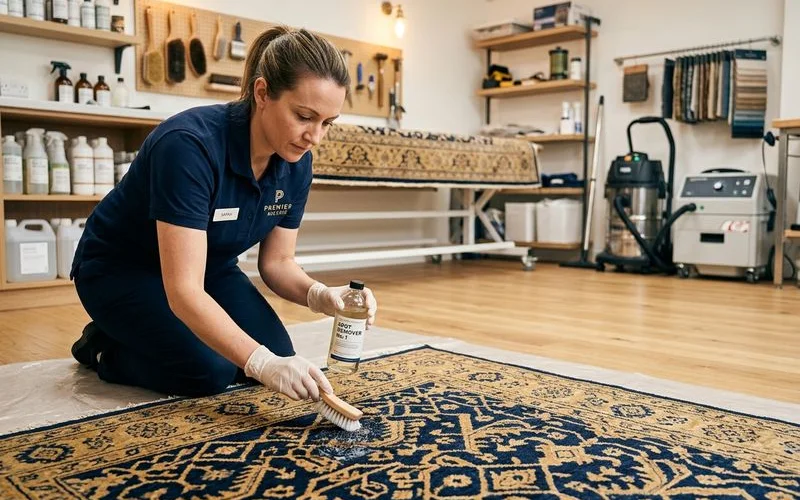
Effective spot response requires immediate action and the strict use of approved, pH-balanced cleaning solutions. Untrained staff or homeowners often cause irreversible dye stripping by using high-pH degreasers or bleach-based bathroom cleaners on wool.
We train property housekeeping teams during program onboarding to avoid these exact mistakes.
A 2026 standard for housekeeping productivity emphasizes that the correct response time and tools prevent a 5-minute spot job from becoming a permanent stain. Our commercial rug cleaning schedule always includes specialized training for daily maintenance teams.
- Blot immediately, never rub: Friction distorts the pile and pushes the stain deeper into the cotton foundation.
- Use approved spot products only: Only use Carpet and Rug Institute (CRI) Seal of Approval certified spotters.
- Document all incidents: Taking a quick photo of significant spills helps us plan the next deep cleaning treatment.
- Escalate complex problems: Set stains or heavy pet accidents need professional extraction to prevent deeper damage.
How Does Proactive Repair Work?
Proactive repair identifies and fixes minor structural damage before it requires a total rug restoration. Catching a loose fringe early prevents the entire end of the rug from unraveling into the main design.
Our routine inspections focus heavily on identifying these small vulnerabilities during every cleaning visit. A loose fringe caught at 1 inch is typically a $200 repair, but that same fringe unraveling to 6 inches becomes a $1,500 repair and often involves permanent pile loss.
We utilize guidelines from the Institute of Inspection, Cleaning and Restoration Certification (IICRC) to catch selvage breakdown early. For properties with pets, untreated urine accidents trapped in the cotton foundation cause rapid dry rot. This turns a flexible rug brittle and leads to immediate structural failure. For ongoing repair work, see Rug Repair & Restoration.
- Selvage breakdown: Fraying along the side edges.
- Fringe wear: Tearing or detachment at the ends.
- Foundation weakness: Cracking sounds when the rug is rolled.
- Dry rot: Stiff, brittle areas often caused by pet incidents.
- Pile compression: Flattened wool in heavy traffic lanes.
Why Is Rotation Important Where Feasible?
Rotating commercial rugs evens out physical wear and significantly mitigates uneven sun fading. A 180-degree rotation every 6 to 12 months extends the useful life of a rug by 25% to 50%.
We always evaluate rotation feasibility for lobby and corridor pieces during our audits. Large commercial windows often cast intense UV rays onto specific sections of a rug, and regular rotation prevents one side from becoming permanently bleached.
We recommend altering traffic patterns through strategic furniture placement for massive, un-rotatable ballroom carpets.
- Sizing: Corridor runners rotate easily, while massive statement carpets require more planning.
- Sunlight Exposure: Areas near large windows require more frequent rotations.
- Traffic Funnels: Entryways experience focused wear that must be distributed evenly.
- Furniture Alteration: Massive pieces require traffic pattern variations through seating adjustments.
How Should We Approach Replacement Planning?
Planning the replacement cycle prevents emergency purchases and allows facility managers to budget accurately for new assets. Even with optimal care, proper maintenance only delays the inevitable end of a rug’s physical lifespan.
We provide detailed condition forecasts during routine inspections so you know exactly when a rug will age out.
Lifecycle costing models used by estate managers show that budgeting for replacements over a decade is far more efficient than waiting for failure. Our team uses specific durability benchmarks to help forecast these capital expenses.
| Rug Construction Type | Expected Service Life | Commercial Viability |
|---|---|---|
| Wool Hand-Knotted | 15 to 25 years | Excellent with proper maintenance |
| Quality Machine-Made Wool | 8 to 12 years | Good for moderate traffic |
| Synthetic High-Traffic | 5 to 8 years | Cost-effective short term |
| Tufted Rugs | 5 to 7 years | Limited use case for commercial |
What Is the ROI of Program Maintenance?
A managed maintenance program costs more annually than ad-hoc cleaning but delivers a massive return on investment by deferring replacement costs. Recent 2026 commercial facility data shows that proactive maintenance programs yield an 11% to 18% ROI simply by extending the lifecycle of expensive flooring assets.
We design programs that lower the per-event cleaning cost and make budgeting entirely predictable, much like the structured rug care programs for hotels, casinos, and country clubs we run across the valley. Waiting until a rug looks visually dirty means the abrasive dry soil has already scratched and degraded the wool fibers.
This ad-hoc approach guarantees faster wear and earlier replacement. Our clients save tens of thousands of dollars on valuable hand-knotted hospitality rugs by simply delaying replacement for another five to ten years.
“Delaying a $50,000 commercial carpet replacement by just five years drastically transforms a property’s operational budget and bottom line.”
If you are ready to implement a strategy to extend commercial rug life, contact us through our contact form to schedule a site audit.
Related Service
Commercial & Hospitality Rug Cleaning
Managed, off-site rug care programs for hotels, casinos, country clubs, and offices, built around your operations.
Learn more about CommercialRelated Rug Care Guides
Off-Site Bulk Rug Cleaning Logistics
How off-site bulk rug cleaning works for businesses, pickup and transport, plant capacity, tracking, and scheduling around your operating hours.
Rug Care Programs for Hotels, Casinos & Country Clubs
Managed rug maintenance for Las Vegas hospitality, scheduled rotations, inventory tracking, and brand-standard presentation that keeps guest spaces flawless.
Frequently Asked Questions
How often should commercial rugs be cleaned?
Does fiber protection help in commercial settings?
How can we extend rug life?
Have a Rug You'd Like Us to Look At?
Free pre-inspection, transparent quoting, and white-glove pickup across Las Vegas.
Get My Free Quote