Can a Urine-Damaged Rug Be Saved?
Whether a urine-damaged rug can be saved depends on dye and fiber damage, extent, and the pad. How a pre-inspection decides treat, repair, or replace.
You know how frustrating it is to deal with a lingering pet odor on a beautiful heirloom rug.
When an owner brings us a heavily contaminated piece, the first question is usually: can a urine damaged rug be saved? Our team at Legacy Rug Cleaning specializes in rescuing these delicate pieces from permanent damage.
The honest answer always depends on specific chemical and structural factors we identify during pre-inspection. For a look at the broader service, you can review our Pet Urine Odor Removal process.
We will break down exactly what the data tells us and walk through a practical framework for making the right choice.
What we look at during pre-inspection
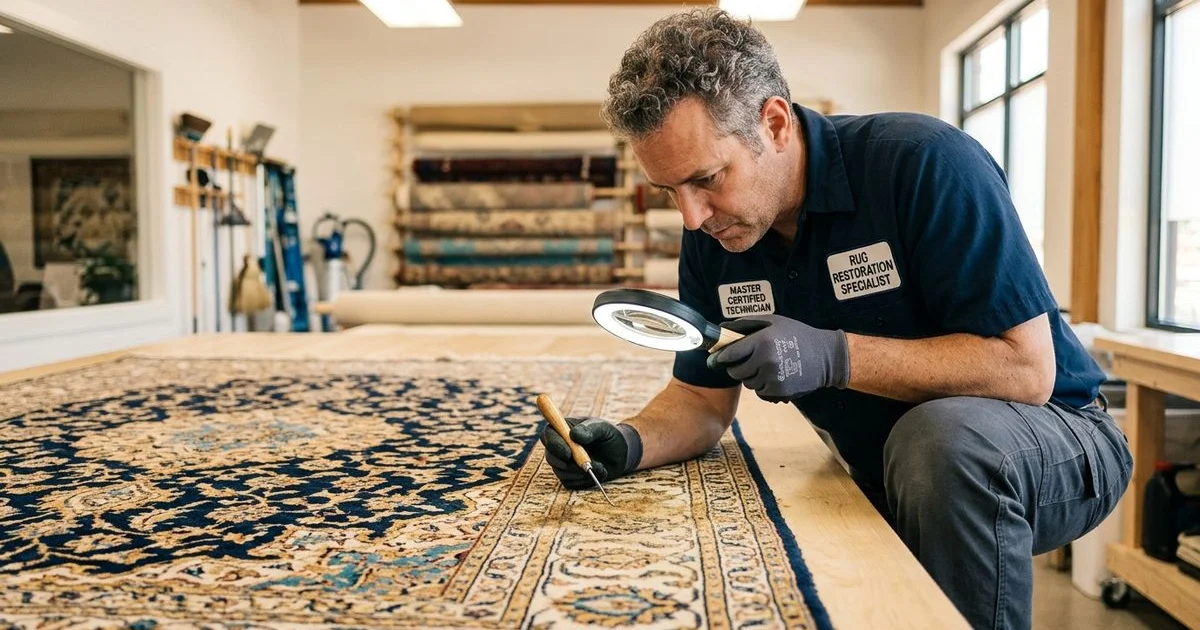
During our initial evaluation, we analyze the structural and chemical damage to determine if the piece can withstand a full wash. This step reveals exactly what is happening beneath the surface to help answer the common worry, is my rug ruined by pet urine.
To give you the most accurate prognosis, we evaluate several critical categories.
Extent of Contamination and Fiber Condition
Our first priority is mapping how much of the rug is actually affected. Localized urine on a small section is usually salvageable. Whole-rug contamination from years of repeated incidents is significantly harder to treat. We then assess the actual fiber condition. Pet urine starts slightly acidic, hovering around a pH of 6.0 to 6.5. As bacteria break down the urea into ammonia, that pH quickly skyrockets to a highly alkaline 10 or higher. This severe alkaline shift strips the natural lanolin from wool and destroys the delicate protein integrity of silk.
Dye Damage and Foundation Integrity
This same alkaline shift is responsible for breaking down dye chromophores. Some light yellowing is reversible, but complete dye loss requires a different conversation. We also check the foundation integrity very closely. Prolonged urine exposure literally rots the inner cotton foundation of the rug. We flex the textile gently to feel for structural stiffness and listen carefully for cracking.
Pad and Subfloor Assessment
The final check involves the padding and the floor beneath it. Contaminated pads are almost always a total loss. Urine easily breaches standard padding to reach your hardwood or subfloor, which dictates the complete remediation plan.
When restoration is worth it
Restoring a rug is almost always a smart investment for hand-knotted Persian, antique, or deeply sentimental pieces. These high-end textiles retain their value, making professional intervention a logical choice.
A true hand-knotted rug, like a traditional Tabriz or Oushak, is designed to last for generations. The combination of submersion decontamination and follow-up repair can recover rugs that look unsalvageable. We see incredible results by fully flushing the uric acid crystals out of the foundation.
Sentimental rugs, regardless of market value, are also usually worth trying. You will always receive an honest assessment from us about the expected outcomes.
When restoration may not be economical
We generally advise against full decontamination for inexpensive machine-made synthetics or hand-tufted pieces with degraded backings. In these cases, the math simply does not work in your favor.
As of 2026, professional restoration averages $3 to $8 per square foot. Inexpensive machine-made rugs often cost less to replace entirely than to properly wash. We will always tell you when that is the case rather than charge you for work that offers no real return on investment.
Hand-tufted rugs present a very specific problem. These rugs rely on a latex glue backing to hold the fibers together. Pet urine acts as a solvent that rapidly degrades this latex, which is often bulked up with cheap marble dust fillers. The degraded latex backing will delaminate and release a sour, crumbling mess that limits the rug’s remaining life.
Signs a rug might not be worth saving:
- The latex backing is visibly peeling or crumbling onto the floor.
- The cost to clean exceeds the current retail replacement price.
- The rug is a modern, synthetic machine-made piece.
- Heavy dry rot has already caused the inner cotton foundation to tear.
Outcomes you can expect
You can expect complete odor neutralization and a return to a soft, natural texture for structurally sound rugs. While our success rate is incredibly high, certain chemical changes simply cannot be undone.
To make the decision easier, we have broken down the typical results of a professional wash.
| Highly Likely Outcomes | Difficult or Impossible Outcomes |
|---|---|
| Complete odor removal (verified using targeted enzyme treatments) | Full reversal of heavy yellowing on white-ground silk |
| Significant improvement in visible staining | Restoration of dye in areas with complete chromophore loss |
| Some recovery of dye in mildly affected areas | Reversal of foundation dry rot (this must be rebuilt) |
| Restoration of a normal, soft fiber feel | Repair of severely delaminated latex backing |
The pad replacement reality
Replacing the contaminated pad is a non-negotiable step in permanently eliminating pet odors. A compromised pad acts like a sponge, keeping the smell alive even when the rug sitting on top is perfectly clean.
Open-cell foam padding absorbs liquid rapidly. Uric acid crystals remain trapped inside those foam cells and reactivate every time the room humidity rises. Our custom pet-barrier rug pad prevents future incidents from reaching the floor below.
For owners dealing with multiple accidents over the years, the old pad is almost always the actual ongoing odor source after a surface cleaning.
The decision framework
Our process relies on a clear, step-by-step evaluation so you know exactly what you are paying for. This transparent approach removes the guesswork from rug restoration.
When you bring a damaged piece to our facility, we follow a strict protocol:
- A free pre-inspection determines exactly what damage is reversible.
- We provide a detailed written assessment with honest expectations.
- You decide whether to proceed based on the estimated outcome and cost.
- We commit to the final outcomes in writing before any water touches the textile.
We confidently say no to jobs that do not make economic sense. You get an enthusiastic yes for jobs where the final result will clearly justify the work.
We prioritize radical honesty in both scenarios.
If you have a urine-damaged rug you are unsure about, send us photos through our contact form or bring it in for a free pre-inspection.
Our team will look at the damage and tell you exactly what is possible to save a urine soaked rug.
Related Service
Pet Urine Odor Removal
Full submersion decontamination and enzymatic treatment that neutralizes organic pet odors without ruining fibers.
Learn more about Pet Urine & OdorRelated Rug Care Guides
Enzyme Decontamination vs. Surface Cleaning for Pet Odor
Surface spot cleaning masks urine; enzyme decontamination removes it. What each does, how long results last, and why rugs need the deep approach.
How Uric Acid Crystals Damage Rug Fibers
Pet urine isn't just odor, uric acid crystals and bacteria degrade fibers, cause yellowing, and shift pH. The chemistry behind urine damage in rugs.
Removing Pet Urine Stains from Wool & Silk Rugs
Wool and silk are easily bleached or yellowed by urine and harsh products. How fiber-safe treatment removes stains, and when they're permanent.
The Submersion Decontamination Flush Process
The full-immersion process that actually removes pet urine from rugs, bath flush, enzymatic neutralizer, sanitization, controlled drying.
Frequently Asked Questions
Is a urine-soaked rug always ruined?
How do you decide whether to save or replace?
Do I need a new pad as part of the fix?
Have a Rug You'd Like Us to Look At?
Free pre-inspection, transparent quoting, and pickup across Las Vegas.
Get My Free Quote