The Submersion Decontamination Flush Process
The full-immersion process that actually removes pet urine from rugs, bath flush, enzymatic neutralizer, sanitization, controlled drying.
You probably already know the frustration of treating a pet accident, only to smell it again a few weeks later. The truth is that standard sprays fail because they cannot reach the true source of the odor.
Our team relies on a complete rug urine decontamination process to fix this exact issue. The real contamination hides deep inside the tightly woven foundation of your investment, requiring physical extraction.
We will break down the precise steps of this submersion flush.
For a broader look at handling these accidents, you can explore our complete guide on Pet Urine Odor Removal. Let’s examine the science behind this method and why it permanently works.
Step 1: Pre-treatment and inspection
Every successful treatment starts with a rigorous visual and ultraviolet inspection. Fresh pet accidents are slightly acidic, but they quickly dry into highly alkaline uric acid crystals with a pH of 10 to 12.
Our specialists use high-powered UV lighting to map out every single hidden deposit. Treating only the visible stains leaves behind invisible odors that a pet can easily detect.
The inspection process reveals three specific issues:
- Alkaline dye bleeding: Old urine can permanently strip color from natural fibers.
- Foundation rot: Heavy saturation weakens the cotton warp and weft yarns.
- Hidden crystal clusters: Dried salts that require extended enzyme dwell time.
Our technicians apply a targeted pre-treatment directly to these problem zones. The protease enzymes immediately begin digesting the hard protein shells, preparing the deep contamination for the main wash.
Step 2: Submersion decontamination bath
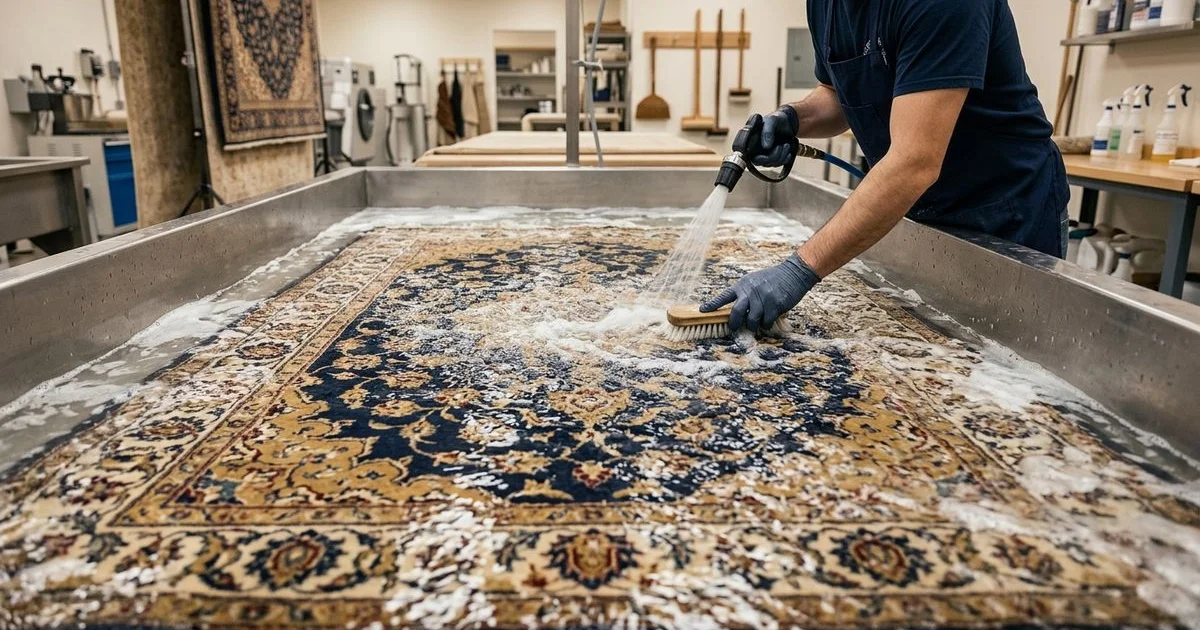
The rug goes into a dedicated wash tank for a deep rug submersion flush. Uric acid crystals are extremely stubborn and essentially insoluble in standard water-based surface cleaners.
Our facility uses a specialized pool of purified, pH-balanced water to completely saturate the item. Full immersion is the only guaranteed way to push cleaning agents deep into the foundational backing of the rug.
We maintain a constant, gentle flow of water to physically dissolve and flush out the reactivated salts. Surface cleaning simply cannot reach these embedded contaminants.
The differences between these approaches are significant:
| Feature | Submersion Bath | Surface Extraction |
|---|---|---|
| Crystal Removal | Dissolves 100% of deep uric acid salts | Only reaches top pile layer |
| Water Usage | Full foundation saturation | Light topical spray and vacuum |
| Odor Result | Permanent elimination at the molecular level | Temporary masking of smells |
Our process ensures the contamination is genuinely flushed out, rather than just temporarily masked.
Step 3: Enzymatic neutralization
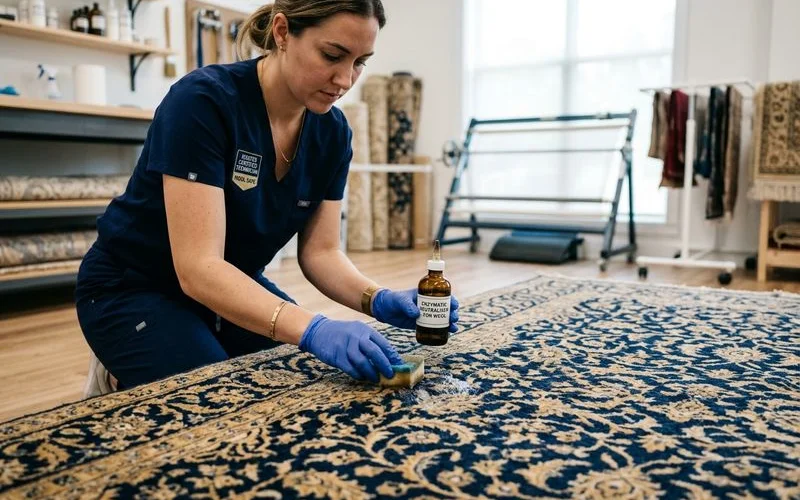
Residual compounds can occasionally survive the initial water flush. The next phase involves applying advanced neutralizers to break down any remaining microscopic proteins.
Our team relies heavily on specialized protease enzymes for this exacting work. These biological agents actively digest the organic compounds that cause lingering smells.
We carefully calibrate this chemistry for the specific fiber type. Applying the wrong solution to natural animal fibers can cause irreversible damage.
The neutralizing products must meet strict industry standards:
- WoolSafe-approved chemistry: Guarantees the pH level will not strip the natural oils from wool scales.
- Gentle silk protocols: Protects delicate silk threads from chemical burns.
- Targeted digestion: Destroys urochrome pigments without affecting the original commercial dyes.
Our targeted approach eliminates the food source for odor-causing bacteria.
Step 4: Sanitization rinse
A specialized sanitizing rinse always follows the enzymatic neutralization. Microbes actually feed on residual pet waste and release strong ammonia gases as a byproduct.
Our sanitization process specifically targets and destroys these odor-causing bacterial colonies. Nearly 94 million United States households now own a pet, making thorough sanitation vital for multi-pet environments.
“A common mistake in DIY pet cleanup is ignoring the bacterial load. If you do not eliminate the microbes feeding on the urine, the ammonia smell will inevitably return when humidity rises.”
We utilize safe, hydrogen peroxide-based solutions formulated at low concentrations to handle this. This specific mixture destroys the cellular walls of the bacteria without harming delicate fiber dyes.
The final rinse leaves the rug completely clean and free of microbial activity.
Step 5: Controlled drying
Proper moisture removal is just as critical as the deep urine rug cleaning itself. The Environmental Protection Agency notes that mold can begin developing within 24 to 48 hours in damp indoor spaces.
Our Las Vegas facility prevents this entirely by moving washed items directly into a climate-controlled room. Uncontrolled ambient drying invites disaster, including color migration, foundation warping, and mildew growth in the thickest areas.
We utilize a state-of-the-art vertical controlled-drying tower to manage the environment. This system uses professional dehumidifiers to strictly maintain the relative humidity between 30% and 50%.
The tower setup provides three distinct advantages:
- Gravity assistance: Hanging the rug allows excess water to naturally drain away from the foundation.
- 360-degree airflow: Centrifugal fans circulate dry air across both the front and back of the piece simultaneously.
- Tension relief: Even weight distribution prevents the cotton warp yarns from stretching or warping out of shape.
Our strict moisture protocols guarantee the rug is completely dry before it ever leaves the building.
Step 6: Verification and assessment
Every piece must pass a strict quality control inspection before a return delivery is scheduled. The foundation of a thick woven rug can hold hidden moisture long after the surface feels completely dry.
Our quality assurance technicians rely on specific tools and tests to verify success:
- Digital moisture meters: Probes check the deep cotton core to ensure zero moisture remains.
- Direct scent analysis: Technicians check the previously contaminated zones closely to confirm full neutralization.
- Visual pile inspection: Technicians groom the fibers to ensure they are soft, aligned, and residue-free.
We immediately send the item back for re-treatment if any trace of odor remains. Complete honesty dictates our approach if fundamental fiber damage prevents 100% odor removal.
Our team will always explain the exact condition of your piece before it returns to your home.
Why this differs from surface methods
The United States pet industry reached an incredible $158 billion in 2025, with millions spent on temporary cleaning fixes. Most retail spot cleaners use heavy fragrances to cover up smells rather than eliminate them.
You can compare this deep washing technique to traditional extraction in our guide on enzyme decontamination vs surface cleaning. The short version is that surface methods only address the visible top layer of the pile.
Our submersion process physically removes the microscopic crystals that actually cause the smell. Standard carpet wands simply lack the ability to penetrate a dense woven foundation. We focus on providing a result that is genuinely clean at the molecular level, which permanently solves the problem instead of just managing the symptoms.
What about the rug pad and floor
Liquid naturally travels downward, meaning the padding beneath your rug absorbs a massive portion of the initial accident. Standard rug cushions act exactly like giant sponges, trapping the moisture and odor directly against your floor.
Our technicians almost always recommend replacing the contaminated padding to ensure complete remediation. You can easily include a fresh, moisture-resistant pet-barrier pad as part of your scheduled service.
We also urge clients to check the condition of the hard surfaces beneath the textile. Pet accidents commonly damage three types of subfloors:
- Hardwood planks: Acidic waste can turn the wood fibers permanently black.
- Concrete slabs: The porous surface absorbs and holds onto uric acid crystals.
- Laminate flooring: Moisture causes the pressed wood layers to swell and buckle.
If your subfloor requires attention, the team will walk you through the proper cleanup options for the room.
A full submersion wash is the absolute foundation of a true rug urine decontamination process. Contact our facility today to schedule an inspection and permanently eliminate those stubborn smells.
Related Service
Pet Urine Odor Removal
Full submersion decontamination and enzymatic treatment that neutralizes organic pet odors without ruining fibers.
Learn more about Pet Urine & OdorRelated Rug Care Guides
Can a Urine-Damaged Rug Be Saved?
Whether a urine-damaged rug can be saved depends on dye and fiber damage, extent, and the pad. How a pre-inspection decides treat, repair, or replace.
Enzyme Decontamination vs. Surface Cleaning for Pet Odor
Surface spot cleaning masks urine; enzyme decontamination removes it. What each does, how long results last, and why rugs need the deep approach.
How Uric Acid Crystals Damage Rug Fibers
Pet urine isn't just odor, uric acid crystals and bacteria degrade fibers, cause yellowing, and shift pH. The chemistry behind urine damage in rugs.
Removing Pet Urine Stains from Wool & Silk Rugs
Wool and silk are easily bleached or yellowed by urine and harsh products. How fiber-safe treatment removes stains, and when they're permanent.
Frequently Asked Questions
What is a decontamination flush?
Does it guarantee odor removal?
How long does the process take?
Have a Rug You'd Like Us to Look At?
Free pre-inspection, transparent quoting, and pickup across Las Vegas.
Get My Free Quote