
Preventing Mold & Dry Rot After Water Damage
Wet rugs grow mold and dry rot fast. The moisture timeline, why controlled drying and antimicrobial treatment matter, and how the foundation is checked.
You know how quickly a simple spill can turn into a massive headache. Proper rug mold prevention water damage control is a race against the clock. The fight against a wet rug mold smell and structural decay defines an effective emergency response.
Our team at Legacy Rug Cleaning handles these emergencies constantly, and the margin for error is razor-thin.
Both mold and dry rot develop fast in the right conditions. They cause secondary destruction that is often harder to reverse than the original wetness.
We want to share the exact timeline of how moisture breaks down an antique or custom piece.
This practical guide will walk through the science of structural drying, the warning signs of rot, and the standard procedures for Water Damage Restoration. Let’s look at the data and explore the exact steps to protect your investment.
The moisture timeline
According to 2026 data from the US Environmental Protection Agency (EPA), mold spores begin to germinate within 24 to 48 hours of moisture exposure. Typical indoor air contains anywhere from 500 to 10,000 dormant fungal spores per cubic meter. We see this biological clock start ticking the second water hits a textile.
Water intrusion acts as a rapid activation switch for these dormant spores. A moldy rug is usually the result of missing this critical window. Our technicians rely on a specific timeline to determine salvageability:
- 0 to 24 hours: Surface drying begins if airflow is present. Fungal spores hydrate and metabolic activation begins, though there is no visible growth yet.
- 24 to 48 hours: Early-stage colonization starts in warm, humid conditions. Color migration from unstable vegetable dyes accelerates, and the chemistry of foundation fibers starts to shift.
- 48 to 72 hours: Visible mold patches start forming, and musty odors become prominent. At this point, dye migration often becomes a permanent stain.
- 3 to 7 days: Deep mold colonization establishes itself throughout the inner warps and wefts. The cotton foundation begins to lose significant tensile strength.
- Beyond one week: Severe dry rot becomes highly probable in saturated areas. Reversing the structural damage becomes nearly impossible.
The first 48 hours remain the absolute critical window for successful rug mold prevention water damage control. Immediate extraction within this timeframe drastically improves your chances of saving an heirloom piece.
We always urge clients to act quickly rather than waiting to see if it dries on its own.
Why controlled drying matters
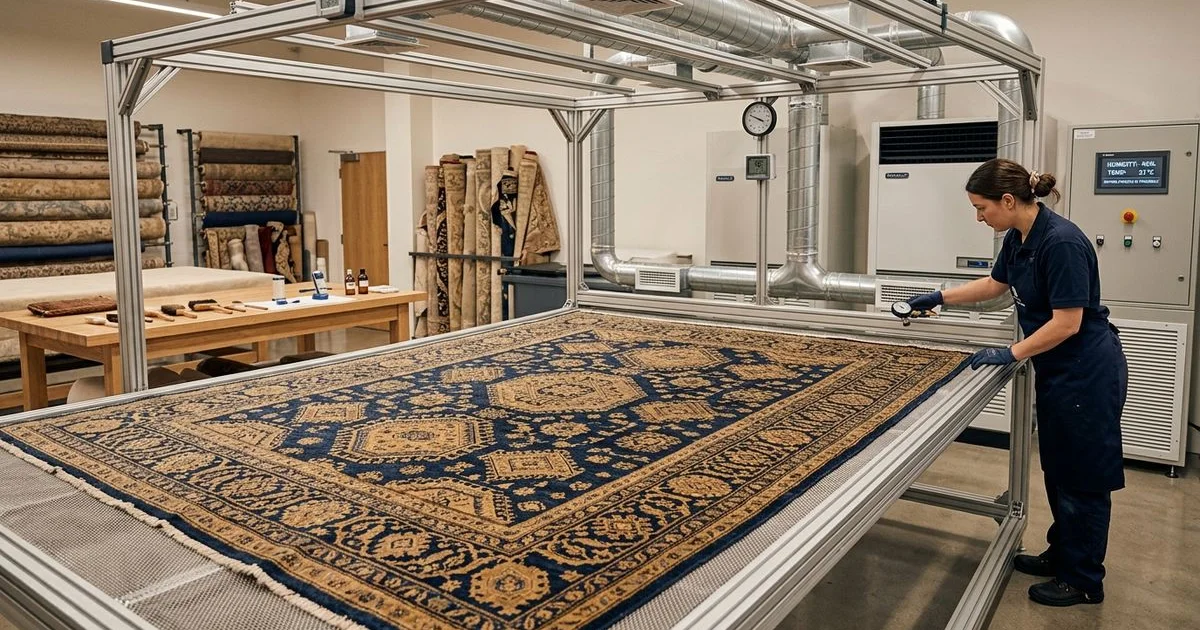
A wet rug needs to dry, but the environment dictates whether the textile survives the process. Standard guidelines from the ANSI/IICRC S500 dictate specific structural drying protocols for water damage restoration. Our controlled-drying facility regulates humidity and airflow to meet these strict industry standards.
Household box fans merely push wet air around a room, which leaves hidden moisture trapped inside dense wool pile. Commercial dehumidifiers and specialized air movers are necessary to pull moisture out of the foundation before secondary damage occurs. We utilize vertical drying towers to ensure gravity and airflow work together evenly.
| Factor | Uncontrolled Home Drying | Controlled Professional Drying |
|---|---|---|
| Environment | Flat on the floor in a room without climate control | Vertically hung in a humidity-regulated facility |
| Airflow | Relies on natural evaporation or standard household fans | Uses industrial air movers for consistent, directed circulation |
| Risks | Uneven drying causes severe warping and permanent dye migration | Prevents localized heat spots and shrinkage |
| Outcome | Wet areas mildew while dry areas finish, causing permanent damage | Evens out the drying rate and maintains complete color stability |
Leaving a rug outside in direct sunlight introduces localized hot spots that cause severe shrinkage. Hanging it over a railing without tension leads to permanent warping and stretched foundation fibers.
Our approach limits the total time the textile spends wet, which is the only reliable way to prevent microbial growth.
Antimicrobial treatment
Fast drying alone cannot address the bacteria or spores that started colonizing during the initial wet period. Professional remediation requires EPA-registered botanical disinfectants to neutralize these threats safely.
We apply these targeted treatments during the specialized wash phase of water-damage restoration.
- Targeted Extraction: Removing the bulk of the contaminated water before washing begins.
- EPA-Registered Application: Utilizing hospital-grade solutions that are proven to eliminate bacteria without degrading natural wool fibers.
- Deep Penetration: Ensuring the treatment reaches the dense inner knots where dormant spores typically hide.
- Final Neutralization: Washing away the remaining organic load so fungi have nothing left to feed on.
This step happens right after controlled extraction and just before the final drying process. Products like Benefect Decon 30 or similar hospital-grade solutions handle heavy soil loads without damaging delicate wool fibers.
Our wash process eliminates both visible surface mold and the unseen dormant spores that would easily resurface on a humid day.
Chemical Warning: Never use standard household bleach on a hand-knotted piece. Bleach destroys the cotton foundation and causes rapid, irreversible dry rot.
The industry refers to this comprehensive approach as the “Clean, Kill, Coat” method.
We strictly avoid harsh synthetic chemicals that compromise the structural integrity of natural vegetable dyes.
Foundation inspection
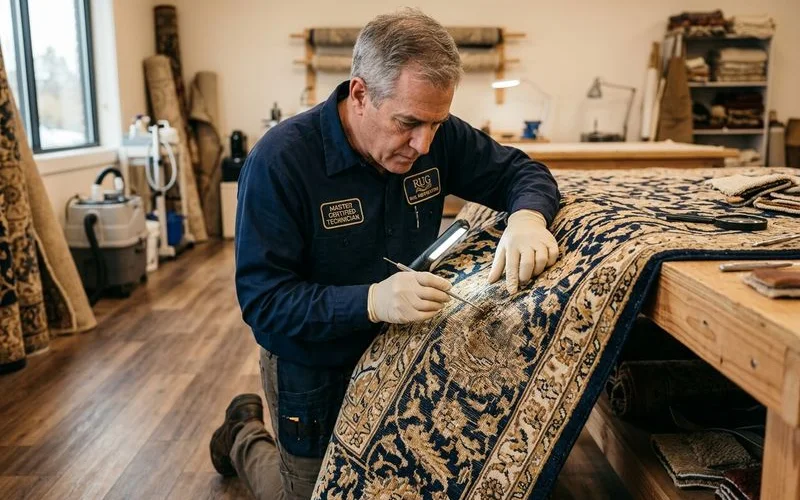
After the drying phase concludes, the next step involves a rigorous assessment of the textile’s inner skeleton. Dry rot is a highly misleading term, as the deterioration always stems from previous moisture exposure.
We pay special attention to cellulosic materials like the cotton or jute used in the warp and weft.
- Rapid absorption: Plant-based foundation fibers take in water instantly and lose their tensile strength.
- Unnatural stiffness: The manual flex test involves gently bending sections to feel for rigidity.
- Acoustic warnings: A severely rotted area will actually sound like solid wood when tapped with your knuckles.
Our technicians listen closely for a distinct crackling sound, which indicates the inner threads are snapping.
You can see what is dry rot and can it be reversed for a deeper look at the structural implications.
Pro Tip: If your rug feels stiff to the touch or makes a snapping sound when you gently roll it, stop handling it immediately. Bending a compromised foundation will cause a permanent tear.
If we discover this type of severe decay, the affected zone requires complete stabilization. The damage is carefully documented so a parallel repair project can begin. Rebuilding the foundation is a highly specialized skill.
Our restoration team can successfully reweave and rebuild these rotted sections in most cases.
When mold has spread
Localized surface mildew is usually an addressable issue if caught early enough. Fungi that have colonized deeply throughout a dense wool foundation present a much harder challenge.
We evaluate the exact source of the water before attempting any remediation.
Clean water from a broken supply line provides a very different prognosis than a Category 3 sewage backup. Black water events introduce dangerous pathogens, making complete decontamination impractical or unsafe for certain textiles.
- Water Category: Clean water (Category 1) is highly salvageable, while raw sewage (Category 3) often dictates disposal.
- Saturation Time: Anything left wet for more than 72 hours faces severe structural degradation.
- Dye Stability: Highly unstable vegetable dyes may bleed permanently if not stabilized immediately.
- Rug Construction: Dense, hand-knotted foundations trap more moisture and take longer to decontaminate than thin weaves.
Our experts will always give you an honest assessment about whether an antique rug is actually salvageable.
The longer a piece sits wet, the more decisions are taken out of human hands by simple chemistry. Fungal growth accelerates exponentially after 72 hours of continuous saturation.
We know that the speed of a professional response is the single biggest determinant of your final outcome.
Insurance coordination
Most significant water-damage events involving valuable home furnishings require coordinating with an insurance provider. Adjusters in 2026 require hard, verifiable data to approve replacement or restoration costs.
We document the damage at every single stage of the process to protect your claim.
- High-resolution photography: Capturing the immediate aftermath before any extraction begins.
- Moisture mapping: Identifying the exact spread of the water footprint.
- Infrared thermal imaging: Providing the exact visual proof of hidden moisture that insurance companies demand.
Direct billing to the insurance carrier is often possible through our office once the claim is authorized.
Insurance Pro Tip: Do not wait for an insurance adjuster’s approval to begin emergency water extraction. Your policy requires you to mitigate further damage immediately.
You can find detailed steps on handling this process in our guide to rug water damage insurance claims. The absolute worst thing you can do during a flooding event is wait for a callback before starting extraction.
We strongly recommend making the call for emergency services right away.
The first 24 hours are simply too valuable to spend wondering whether to get professional help for rug mold prevention water damage issues.
Related Service
Water Damage Restoration
Emergency containment, mold prevention, and restorative care for flooded and water-damaged rugs, with insurance coordination.
Learn more about Water DamageRelated Rug Care Guides
Working with Insurance on Rug Water Damage Claims
Filing a claim for a water-damaged rug? What documentation and valuation you need, how we coordinate directly with insurers, and repair-vs-total decisions.
What to Do When Your Area Rug Floods
Acting fast saves a flooded rug. Stop the source, blot and elevate, get professional pickup quickly, plus what NOT to do that makes damage permanent.
Frequently Asked Questions
How fast does mold grow on a wet rug?
Can a moldy rug be saved?
Does water damage cause dry rot?
Have a Rug You'd Like Us to Look At?
Free pre-inspection, transparent quoting, and pickup across Las Vegas.
Get My Free Quote