
Working with Insurance on Rug Water Damage Claims
Filing a claim for a water-damaged rug? What documentation and valuation you need, how we coordinate directly with insurers, and repair-vs-total decisions.
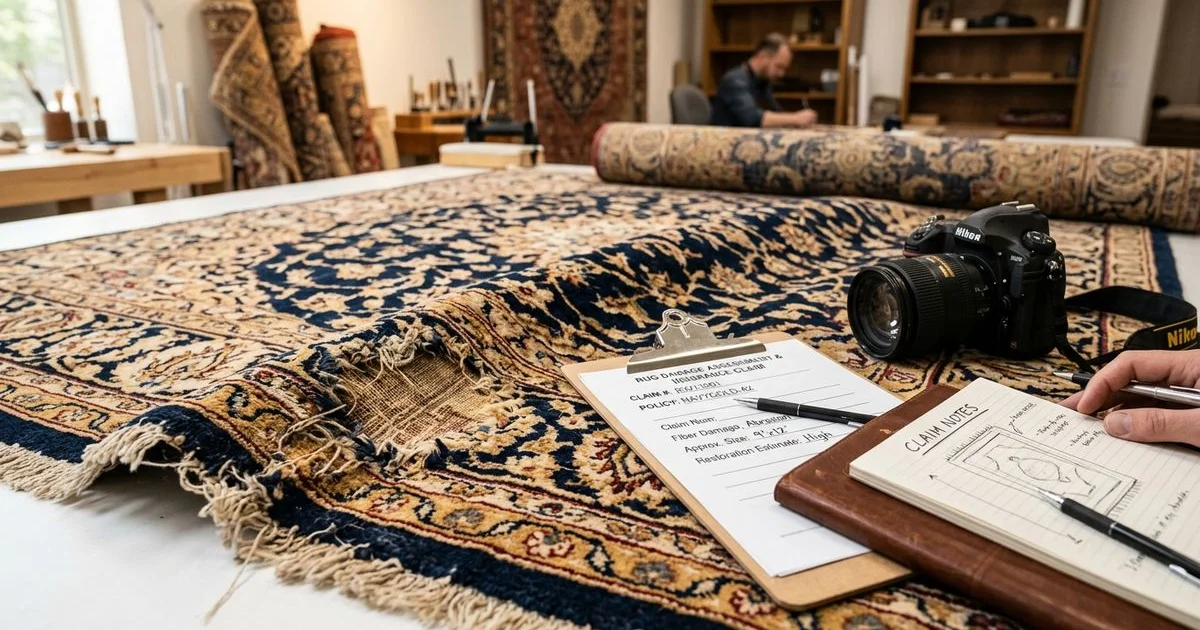
We see it all the time in this industry, where a simple plumbing failure quickly turns into a complex financial headache for homeowners. Recent 2026 data shows the average U.S. water damage claim now exceeds $13,900, making these incidents both common and costly.
Our team at Legacy Rug Cleaning aims to bridge the gap between your immediate crisis and a fair rug water damage insurance claim settlement. The right initial steps — covered in detail in what to do when your area rug floods — will completely change how an adjuster evaluates your loss.
Let’s look at the data behind standard policies, what adjusters actually need to see, and how to handle the specific documentation.
For the broader service, see our complete guide to Water Damage Restoration.
What insurance typically covers
Most standard U.S. homeowners policies, like the common HO-3 form, cover sudden and accidental water damage to your rugs. Standard baseline coverage almost always excludes gradual leaks and outside flooding.
We constantly remind clients that water damage and freezing account for nearly 30% of all property claims according to 2026 industry reports from carriers like Mercury Insurance. Coverage varies meaningfully between carriers and specific plans.
Covered events (most policies):
- Sudden pipe bursts
- Appliance failures (washing machine, dishwasher, water heater)
- Sudden roof leaks from storm damage
- Sewer backup (often requires a specific rider)
- Frozen pipe damage
Excluded events (most policies):
- Gradual leaks (a slow drip ignored over time)
- Maintenance failures
- Flooding (usually requires a separate National Flood Insurance Program policy)
- Pet urine damage
- Wear and tear
Always check your specific policy documents. Our team recommends confirming your exact limits before an emergency happens.

Documentation for the claim
Effective claims require strict proof of both the original cause of loss and the exact value of the damaged item. This documentation must happen before any cleanup permanently alters the scene.
Our process focuses on gathering the specific evidence adjusters need for named-perils coverage. Personal belongings like rugs are usually covered on a “named perils” basis under standard U.S. policies, meaning the burden of proof falls entirely on you.
We break down the required documentation into four distinct categories for clarity. The Federal Emergency Management Agency (FEMA) warns that mold begins growing within 24 to 48 hours, so you must capture this evidence quickly.
- The cause of loss: Take photos of the source, like the burst pipe or the leaking appliance, along with the date and time of the incident.
- The damage to the rug: Capture photos at multiple stages, including before any drying, during the response, and after. Our team documents this professionally as part of the service.
- The rug’s value: Secure a professional written valuation including age, construction, origin, condition before the damage, and current replacement value.
- The cost of restoration or replacement: Provide either an itemized restoration estimate or a replacement quote for a comparable piece.
How we coordinate with insurers
We act as the technical liaison between you and your insurance carrier to ensure accurate communication. This direct coordination prevents common delays and protects your financial interests.
Our standard operating procedure includes providing a USPAP-compliant appraisal, which stands for Uniform Standards of Professional Appraisal Practice, to establish true market value. Adjusters respect this level of professional detail.
For owners working with insurance, the specific steps include:
- Photographic documentation: Tracking visual evidence at every stage from initial pickup through final return.
- Written professional valuation: Detailing the construction, age, condition, and value estimates of the rug.
- Restoration assessment: Providing an itemized scope of work and exact pricing.
- Direct billing: Sending invoices directly to the insurance carrier when authorized by you, which often results in no out-of-pocket cost on covered claims.
- Claim correspondence: Communicating directly with adjusters as needed to answer technical questions.
Repair vs total loss decisions
Insurance carriers decide whether to restore or replace a piece based strictly on the ratio of repair costs to the item’s verified replacement value. A total loss is typically declared when restoration costs approach 70% to 80% of a comparable new rug.
We provide detailed estimates for both scenarios so you and the carrier can make an informed choice. Sentimental or antique value heavily influences this decision, especially for irreplaceable pieces.
Our clients often face confusion regarding how policies calculate this final payout. The distinction between Actual Cash Value and Replacement Cost Value determines your actual reimbursement.
Understanding Valuation Methods
We created this comparison to clarify how your specific policy type impacts the final claim settlement. Standard Actual Cash Value policies heavily depreciate antique rugs based on age and wear.
| Valuation Method | How It Works For Rugs | Financial Impact on Claim |
|---|---|---|
| Replacement Cost Value (RCV) | Pays the current retail price to acquire a comparable new item today. | Higher payout, ensuring you can fully replace the piece without a gap in coverage. |
| Actual Cash Value (ACV) | Pays the depreciated value based on age, wear, and market conditions. | Lower payout, often leaving owners significantly undercompensated for high-end pieces. |
What if the carrier doesn’t want to authorize
Carriers sometimes initially decline coverage, dispute the valuation, or push for the cheapest possible solution for insurance rug damage. This initial pushback is a common tactic, often because adjusters lack specialized knowledge of high-end textiles.
We regularly resolve these disputes through stronger, independent documentation. A verified appraisal often shows a much higher value for hand-knotted antique or designer rugs than carriers initially assume.
Our experience shows these disagreements usually resolve through three specific actions:
- Submitting better, time-stamped documentation of the original cause of loss.
- Providing an independent, professional valuation proving the actual market value of the rug.
- Presenting a clear comparison of restoration costs versus the cost to replace the piece with one of comparable quality.
What about the pad and floor
A covered event that damages your rug usually compromises the underlying pad and may threaten the subfloor. You must address the pad replacement and subfloor cleanup as part of the broader dwelling claim to prevent secondary issues.
We frequently see hidden moisture lead to severe structural damage if ignored for too long. The Environmental Protection Agency notes that structural materials can break down and support mold growth within 48 hours of exposure.
Our technicians can fully address the rug portion of the loss. The broader water mitigation team handles the flooring and environment to ensure the space is safe for the cleaned rug to return.
Documentation we provide
You will receive a comprehensive packet of professional documentation designed specifically for insurance submission. This paperwork removes the guesswork for adjusters and accelerates your reimbursement.
We ensure every detail from pickup to final delivery is officially recorded. Clear evidence is the best tool for securing a fair claim outcome.
When you bring a water-damaged rug to the facility with insurance involvement, the packet includes:
- Photographic documentation from throughout the entire process
- A formal, written valuation of the piece
- An itemized restoration estimate
- Pre-restoration and post-restoration condition reports
- A final invoice formatted specifically for claim submission
Our support extends beyond just cleaning, but if you need pure restoration outside of insurance, see Rug Repair & Restoration.
If you need to file a claim for ruined rug damage, call the shop before you do anything else.
We know the first decisions affect both the physical outcome of the textile and the financial outcome of the claim.
Protect your investment by acting quickly and securing professional guidance.
Related Service
Water Damage Restoration
Emergency containment, mold prevention, and restorative care for flooded and water-damaged rugs, with insurance coordination.
Learn more about Water DamageRelated Rug Care Guides
Preventing Mold & Dry Rot After Water Damage
Wet rugs grow mold and dry rot fast. The moisture timeline, why controlled drying and antimicrobial treatment matter, and how the foundation is checked.
What to Do When Your Area Rug Floods
Acting fast saves a flooded rug. Stop the source, blot and elevate, get professional pickup quickly, plus what NOT to do that makes damage permanent.
Frequently Asked Questions
Does homeowners insurance cover rug water damage?
Do you work directly with my insurance?
What documentation do I need?
Have a Rug You'd Like Us to Look At?
Free pre-inspection, transparent quoting, and pickup across Las Vegas.
Get My Free Quote