
Professional Rug Wrapping for Storage & Shipping
Shipping or storing a rug? Professional breathable wrapping protects against pests, scuffs, and grime, and preps fine rugs for safe out-of-state transit.
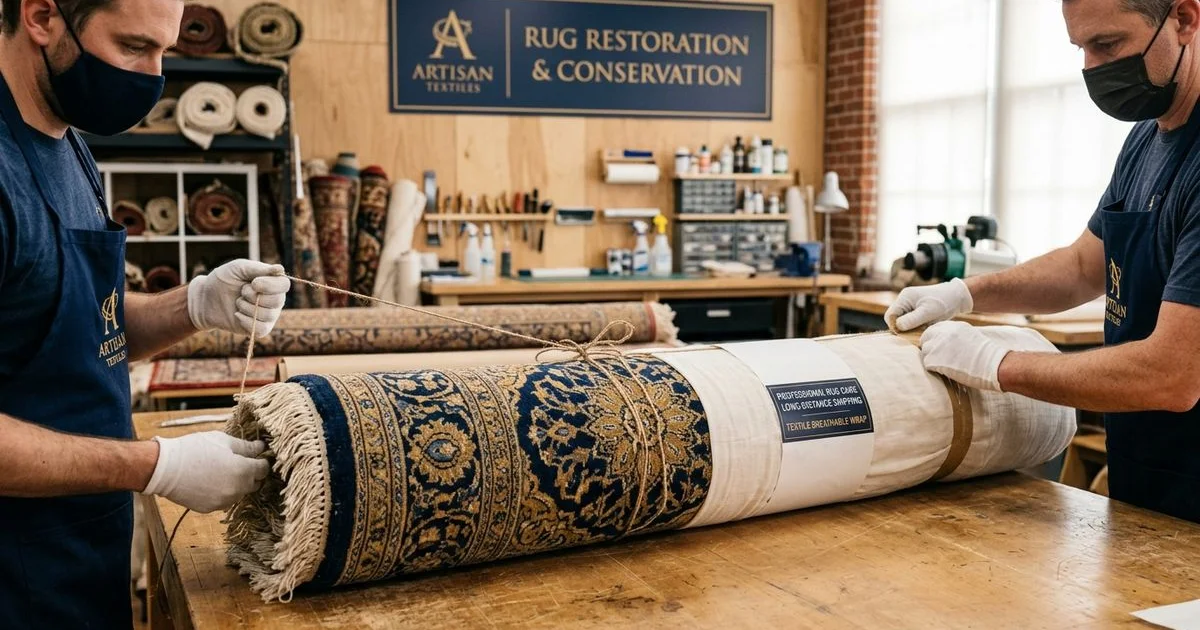
We consistently see standard moving companies treat expensive antique rugs like ordinary floor mats. This oversight often leads to permanent foundation damage. For the broader service, see Rug Storage & Wrapping.
The demand for reliable rug wrapping shipping has grown, and our team knows that proper preparation is the only way to safeguard your investment. You spend thousands on a custom area rug, so tossing it folded into a hot moving truck is a massive risk.
Let’s look at the data behind transit damage and explore the exact wrapping protocols that keep fine textiles safe.
Why standard moving methods fail rugs
Standard household movers often handle rugs the same way they handle other large items by folding them and stuffing them into a truck. This standard approach almost always fails because folding creates permanent creases that weaken the foundation of the rug.
We regularly receive damaged rugs at Legacy Rug Cleaning that suffered from improper packing. The pressure of stacked boxes on a folded wool or silk piece causes the internal knots to stretch and snap.
The damage standard packing creates includes several severe issues:
- Permanent creases from folding that crack the dry foundation.
- Foundation weakness along fold lines due to immense knot stress.
- Scuffing from contact with sharp furniture corners.
- Pest exposure during transit when wrapped in basic moving blankets.
- Moisture absorption if conditions vary across different climate zones.
Our experience shows that wrapping a rug in standard non-breathable plastic creates a greenhouse effect inside the truck. Condensation forms during temperature changes, and that trapped moisture triggers rapid mold growth within 48 hours. Professional rug wrapping addresses all of these risks by utilizing specialized materials.
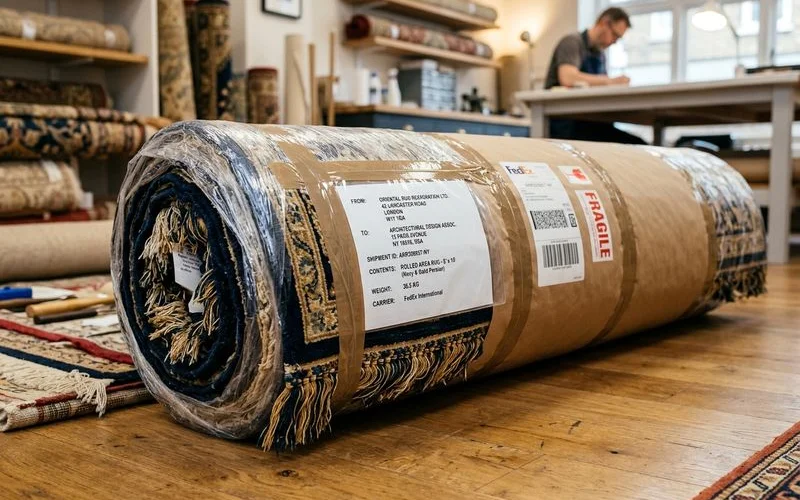
The professional wrap process
Professional wrapping involves a methodical system of cleaning, structural support, and specialized barrier materials. This process guarantees your piece arrives in the exact same condition it left.
Essential Cleaning
Cleaning first. Always. Shipping a dirty rug for long distances accelerates damage in transit and complicates unpacking. Dirt acts like tiny razor blades against the fibers when the rolled rug vibrates in a moving truck. See how to store an area rug long-term for the cleaning-first principle.
Structural Rolling
Rolling. The rug is rolled around a structural core for added rigidity during transit, and it is never folded. Archival cardboard tubes provide the best internal support for this step. The roll is moderately tight, which stays supportive without stressing the delicate foundation.
Our technicians always roll the rug with the pile facing inward. This simple orientation protects the vulnerable silk or wool face from friction.
Breathable Wrapping
Breathable wrapping. Professional textile wrap or acid-free paper is layered around the rolled rug. DuPont Tyvek is the gold standard for this layer because it keeps liquid water out while allowing trapped moisture to escape. The wrap is sized appropriately for the rug’s diameter and length.
Outer Protection and Labeling
Outer protection. For shipping, an extra outer layer protects against scuffs and physical contact. We often apply a heavy-duty 6-mil poly sleeve over the Tyvek for maximum weather resistance during freight transit. For storage, the inner breathable layer is sufficient.
Labeling and documentation. Each wrapped rug is tagged with identifying information. For shipping, this includes the destination, handling instructions, and required carrier tracking numbers.
Shipping specifics
Out-of-state shipping requires precise logistics and specialized carriers to avoid hefty surcharges. Standard parcel services often hit limits quickly with bulky textiles.
Here are the critical factors for specialized transport:
- Carrier selection: Some freight carriers handle textiles much better than others. We use specialized carriers with track records of safe transit, rather than standard ground services. For example, oversized rugs larger than 9x12 often require LTL (Less-Than-Truckload) freight providers like Pilot Freight or TSI White Glove service.
- Insurance: Valuable rugs should be insured for transit at a declared value. The standard carrier liability is often just 60 cents per pound, which is completely inadequate for a handmade Persian rug.
- Climate considerations: Shipping through extreme weather requires extra precautions. Moving a rug from a humid region to a dry climate can cause natural fibers to expand and contract rapidly.
- Tracking: Real-time tracking lets the recipient prepare for delivery and watch for any handling issues in transit.
We strongly advise checking the transit route for extreme climate shifts before booking.
| Shipping Factor | Standard Parcel (UPS/FedEx) | Specialized Freight (TSI/Pilot) |
|---|---|---|
| Best For | Small rugs under 4x6 | Oversized rugs 8x10 and larger |
| Cost Basis | High dimensional weight fees | Flat rate or LTL freight class |
| Handling | Automated sorting belts | Manual White Glove handling |
For interstate shipping
Many clients ask us how to ship a rug safely across state lines. Interstate shipping involves moving heavy textiles across multiple state lines and transfer hubs. A 50-pound rug traveling from New York to California faces significant handling risks if not prepared correctly.
Common interstate shipping scenarios include several specific situations:
- Sending a rug to a new home. Owners moving out of Las Vegas often send valuable rugs ahead via professional freight rather than household movers.
- Receiving a rug from out of state. Owners inheriting or purchasing rugs from other regions often need professional unwrapping and inspection on arrival.
- Shipping for repair. Some restoration work goes to specialists in other regions, and we coordinate the specialized shipping required.
- Returning a rug after seasonal use. Snowbird homeowners ship rugs back and forth between seasonal homes.
Our logistics team can handle the preparation and coordination for each of these scenarios. Sending a rug separately from your main household goods ensures it receives the dedicated attention it requires.
Wrapping for storage vs shipping
The wrapping strategy changes significantly based on the final destination. Both require a clean rug, but the outer barriers serve entirely different purposes.
Here is how the preparation differs:
- Storage wrapping: Focuses on long-term breathability, pest protection, and stable conditions. We use a simpler outer layer because the rug isn’t being handled constantly during storage. A breathable Tyvek wrap or unbleached muslin cloth works perfectly to block moths while preventing mildew.
- Storage climate rule: Our storage protocol explicitly bans sealed plastic bags. Plastic traps condensation, and even a tiny temperature fluctuation can trigger dry rot inside a storage unit.
- Shipping wrapping: Adds heavy outer protection for physical handling. This outer layer includes thick 4-mil plastic sleeves or custom corrugated boxes, extra labeling for carrier identification, and rigid supports for very valuable rugs.
For most owners, the same breathable inner wrap works for both scenarios, but you must change the outer protection.
What to do if you receive a wrapped rug
Receiving a shipped rug requires immediate attention to prevent post-transit issues. You must get the piece out of its heavy shipping plastics to let the natural fibers breathe.
- Unwrap promptly. Do not leave the rug wrapped for weeks waiting to address it. Wrapped rugs kept in tight transit plastics can deteriorate quickly, so open them within 48 hours of delivery.
- Inspect for damage. Look closely for transit issues like water damage, scuffs, deep creases, or new pest evidence.
- Air out before use. Rugs in transit absorb the smells of wherever they have been. Open up the rug in a clean space for a day before placing furniture on it.
- Consider cleaning. A professional cleaning after long-distance transit is often worth it, especially for highly valuable antique pieces.
- Document any damage. Photograph the outer packaging before unwrapping, and report any internal issues immediately to the carrier and your insurance provider. Freight claims usually require notice within a tight 15-day window.
Cost
Professional wrapping for transit typically runs $50 to $200 depending on the rug size and material complexity. Shipping costs are completely separate and depend heavily on distance, exact weight, and your carrier choice.
Our recent 2026 data shows that shipping costs have increased due to new carrier minimums. A medium 6x9 rug might cost $100 to $200 via standard ground shipping in the US. Shipping a large 8x10 rug across the country often starts around $390 and can exceed $1,300 for premium White Glove freight services.
For valuable rugs, the specialized freight cost is a small insurance premium against catastrophic transit damage. For inexpensive synthetic rugs, you may decide that more basic protection is sufficient.
When DIY wrapping is okay
Basic DIY wrapping with breathable material can work for very specific, low-risk situations. This includes short-distance moves, same-city storage in a known climate-controlled facility, or brief transit between rooms during a home renovation.
Our experts recommend using clean cotton sheets or heavy-duty acid-free archival paper if you choose the DIY route. Never wrap standard bubble wrap directly against a wool face, as the plastic circles can leave permanent indentations.
For anything else, hiring a professional rug wrapping service is worth the financial investment. The cost of transit damage to a fine Persian rug far exceeds the initial wrapping cost. If you are planning a move or shipping involving a valuable rug, contact us through our form for prep and coordination.
Related Rug Care Guides
Frequently Asked Questions
How should a rug be wrapped for shipping?
Can you prep my rug for out-of-state shipping?
Is plastic wrap okay for shipping?
Have a Rug You'd Like Us to Look At?
Free pre-inspection, transparent quoting, and pickup across Las Vegas.
Get My Free Quote