Removing Common Stains & Spills from Wool Rugs
Wine, coffee, food, and pet stains on wool, what to blot first, why harsh DIY harms wool, and how professional treatment lifts set stains safely.
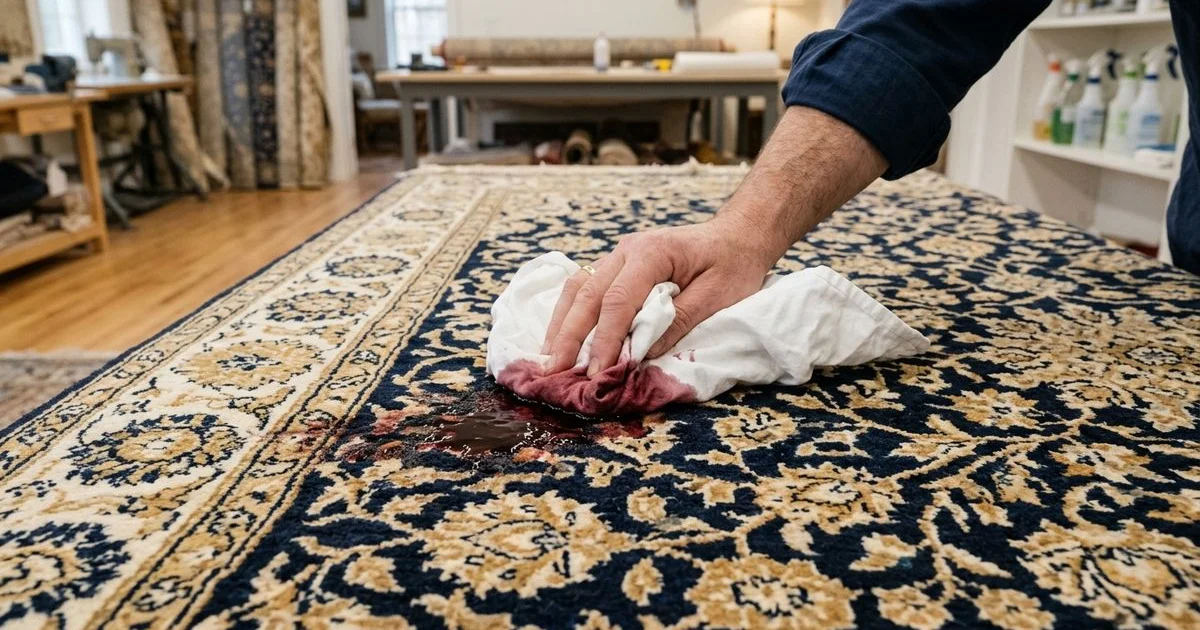
We often see homeowners panic when a spill happens on their favorite piece.
The good news is that wool naturally resists liquids thanks to an outer layer called the epicuticle. This lanolin-rich coating gives you a brief window to act before disaster strikes.
Our team designed this guide to help you master wool rug stain removal safely. You will learn the exact steps to treat fresh spills and avoid permanent damage.
For the broader service, see Wool Rug Cleaning.
The universal first step: blot, don’t rub
We always tell our Las Vegas clients that immediate blotting is the single most important action you can take. A dry, white cotton cloth is your best tool for stopping a spill from becoming a permanent stain. Press the cloth firmly into the spot, lift it straight up, and move to a dry section before pressing again.
Our technicians find this simple action removes the liquid before it reaches the cotton foundation of your rug. You will find this works on water, a fresh wine stain wool rug accident, coffee, and even pet urine. What blotting does not do is clean the actual fibers.
We warn against rubbing because it causes a physical reaction called felting. The tiny scales on the wool fibers interlock when agitated, causing the surface to permanently mat and distort. Agitation also pushes the liquid deeper into the warp and weft.
Common spills and what to do
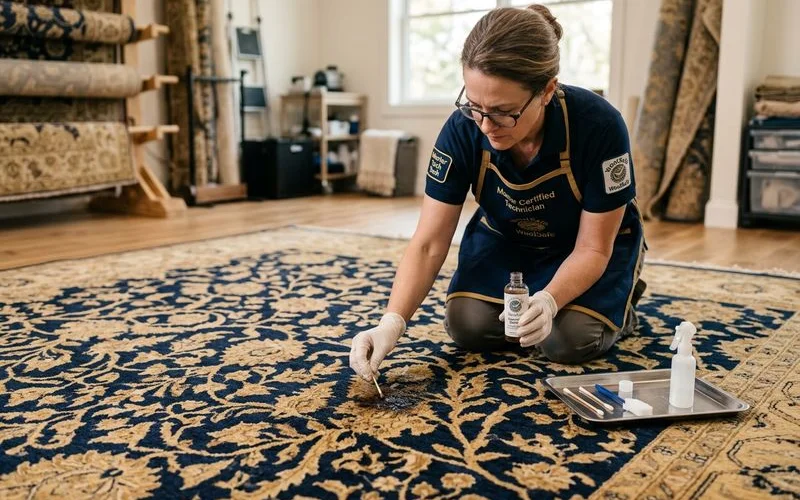
Our team treats hundreds of unique stains every year across the US. Each type of spill requires a specific chemical approach because the pH levels vary wildly. You must identify the substance before taking any further action.
We created this quick-reference table to guide your immediate response. A fresh wine stain wool rug incident requires a completely different approach than an oil spill. A dark coffee stain rug emergency is similarly urgent because heat sets the acidic liquid fast.
| Spill Type | The Chemistry | Immediate Action |
|---|---|---|
| Red Wine | High in tannins and anthocyanins. | Blot immediately with a dry cloth. Call a specialist if color remains. |
| Coffee | Acidic (pH 4.8 to 5.1). Heat sets the stain fast. | Blot up all liquid. Never apply heat. Call a professional for residue. |
| Food (Oils) | Oily residues break down the lanolin in wool. | Scrape solids with a dull edge. Blot the remaining oil. |
| Pet Urine | Starts acidic, shifts to alkaline. | Blot liquid. Call immediately for enzyme treatment. |
| Pet Vomit | Highly acidic stomach enzymes. | Remove solids carefully. Blot the area and schedule professional care. |
| Mud & Dirt | Abrasive silica and soil particles. | Let it dry completely. Vacuum or gently brush away. |
| Blood | Protein-based stain that coagulates. | Blot with cold water only. Warm water will permanently set the proteins. |
Our specialists frequently see DIY attempts make these specific stains worse. Pet urine is especially deceptive because the chemistry changes within hours; see how uric acid crystals damage rugs. The liquid turns from an acid to a strong alkaline as it dries.
We know this shift creates stubborn uric acid crystals deep within the rug foundation. Humid weather will reactivate these crystals and release strong ammonia odors. You need specialized enzyme treatments to break these crystals down safely.
Our experts strongly advise against using consumer pet sprays on natural fibers. Most of these sprays contain harsh chemicals that strip the natural oils from the wool. You risk causing permanent color loss alongside the lingering odor.
Why consumer products are risky on wool
We constantly replace rugs that were ruined by standard supermarket spot cleaners. Most popular American stain removers are built for synthetic nylon carpets, not natural textiles. These formulas contain aggressive surfactants and high alkaline levels.
Our laboratory testing shows a typical over-the-counter spray sits at a pH of 8.5 or higher. Wool requires a delicate, slightly acidic environment between a pH of 4.5 and 5.5. You will cause immediate chemical damage when you apply a synthetic cleaner to a natural fiber.
We see four common types of damage from consumer products:
- Cellulosic browning caused by high pH levels.
- Protein fiber digestion from synthetic-grade enzymes.
- Dye alteration from supermarket bleaching agents.
- Lanolin stripping from harsh chemical surfactants.
Our technicians find that homeowners usually end up creating a permanent bleached spot. The chemically treated area will feel stiff and look distinctly lighter than the surrounding pile. For essential care fundamentals, see why wool rugs need WoolSafe cleaning.
When to call a specialist
We draw a very clear line for our clients on when to seek professional help. Your threshold for DIY intervention should end the moment your dry towel stops picking up liquid. Any colored residue left behind requires specialized chemistry to extract safely.
Our specialists regularly fix damage caused by terrible online advice. You will find thousands of videos promoting white vinegar, dish soap, or baking soda pastes. These household items leave sticky residues that rapidly attract new dirt and soil.
We need three specific details when you contact us about an accident:
- The exact substance and time of the spill.
- The construction type of your rug.
- The history of any previous chemical treatments.
Our team uses this information to prepare the correct WoolSafe neutralizing agents before we arrive. Prompt action helps us determine if you need an emergency pickup or a scheduled appointment. You should also disclose every household product you already applied to the stain.
What specialist treatment can do
We utilize a strict sequence of WoolSafe-approved chemistry for every single job. This professional-grade protocol is specifically calibrated to match the exact pH of your stain. The success rate of this extraction process depends entirely on the age of the spill.
Our technicians categorize stain recovery into three distinct timelines. You can use these benchmarks to set realistic expectations for your restoration project. A fresh stain under forty-eight hours old has an excellent chance of complete, invisible removal.
| Stain Age | Treatment Approach | Expected Outcome |
|---|---|---|
| Fresh (Under 48 Hours) | Gentle pH balancing and cold-water extraction. | Excellent chance of complete, invisible removal. |
| Set (1 to 4 Weeks) | Targeted enzyme applications and dye stabilization. | Significant improvement, though faint shadows may remain. |
| Old (6+ Months) | Advanced color correction and deep flushing. | Permanent dye alteration is likely. |
We always conduct a thorough dye test and pre-inspection before applying a single drop of solution. This transparency ensures you understand exactly what results are physically possible. You deserve complete honesty rather than unrealistic guarantees.
The honest summary
We cannot stress enough that your reaction time determines the fate of your rug. The faster you act, the more reversible the damage will be.
A dry cotton cloth is the only safe tool for those critical first minutes.
Our advice is to always secure a professional evaluation for colored residues. Reaching for a cheap household spray usually turns a minor spot into an expensive restoration.
A targeted intervention today protects the long-term value of your investment.
We are standing by to help you preserve your beautiful textiles. Call us immediately for a consultation so you can save your piece before the stain sets.
Fast action is the best defense against permanent fiber damage.
Related Service
Wool Rug Cleaning
WoolSafe-approved cleaning that preserves lanolin and protects wool from felting, shrinkage, and stain damage.
Learn more about Wool RugsRelated Rug Care Guides
Frequently Asked Questions
How do I get wine out of a wool rug?
Can I use store-bought stain remover on wool?
Are set-in stains removable?
Have a Rug You'd Like Us to Look At?
Free pre-inspection, transparent quoting, and pickup across Las Vegas.
Get My Free Quote