
Common Rug Damage We Repair
Holes, knife cuts, rotted areas, missing corners, vacuum and pet damage, the full range of rug damage we restore, and what's typically repairable.
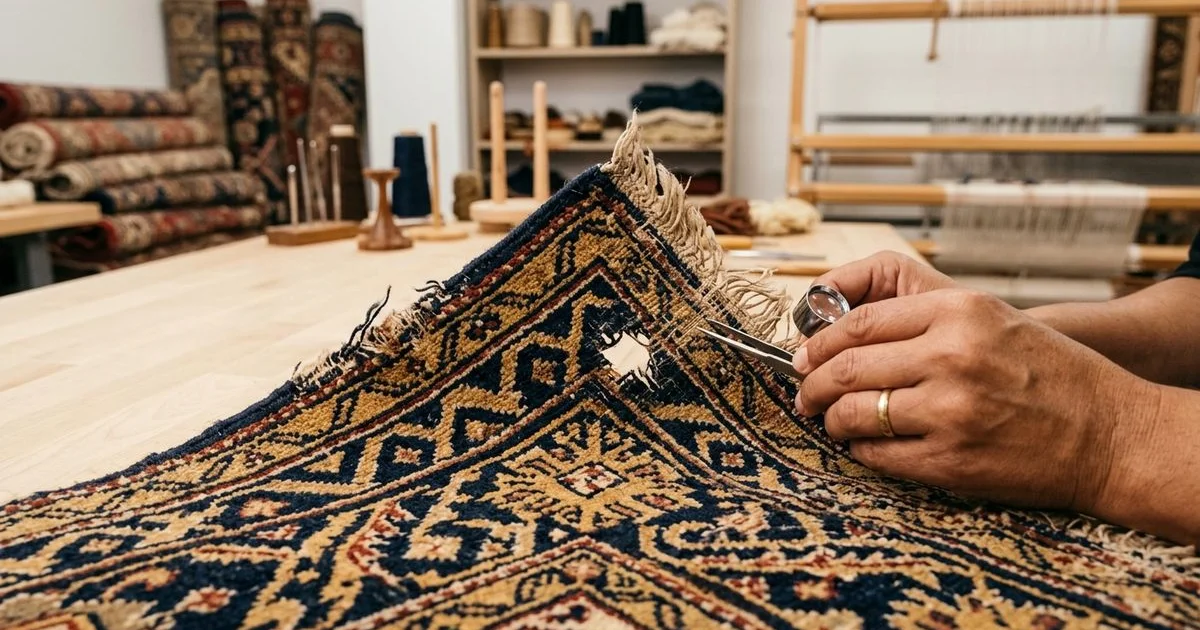
We see many beautiful, hand-woven pieces in Las Vegas that owners mistakenly think are beyond saving. A rug that looks like a total write-off often just needs the right technical attention.
Understanding the different rug damage repair types can save your valuable investment from the landfill.
Professional restoration handles everything from frayed fringes to major structural holes. For a full breakdown of the service, see our Rug Repair & Restoration page. Let’s examine the specific issues routinely fixed in the shop and how the restoration process works.
Vacuum and pet damage
Vacuum damage typically destroys fringes and edges, while pets often cause chewed corners or torn sections. We regularly fix damaged area rug edges caused by upright vacuums with aggressive beater bars. The rotating brush pulls the foundational warp threads, causing the entire end to unravel over time.
Puppies under a year old are notorious for teething on rug corners. Pet urine presents a completely different structural problem. The liquid starts slightly acidic but quickly oxidizes into a highly alkaline substance with a pH of around 10 or 11. This chemical shift burns the wool and rots the underlying cotton foundation.
We rebuild these damaged areas using specialized techniques. Worn fringes receive secure zangir knots to stop the unraveling. Chewed sections get matching pile woven back into place.
To prevent future damage, follow these basic practices:
- Turn off the beater bar setting when vacuuming hand-knotted pieces.
- Use suction-only attachments near the delicate fringe ends.
- Blot pet accidents immediately with a white cotton towel.
Knife cuts and small holes
A knife cut or small hole can usually be rewoven invisibly by rebuilding the foundation and replacing the pile knot by knot. Proper rug hole repair completely restores the structural integrity of the piece. The process requires matching both the exact wool color and the specific knotting technique.
Many fine antique rugs use either a symmetrical Turkish knot or an asymmetrical Persian knot. We identify the original construction method before weaving a single new thread. The damaged warp and weft cords are carefully spliced with high-tension cotton to create a strong new base.
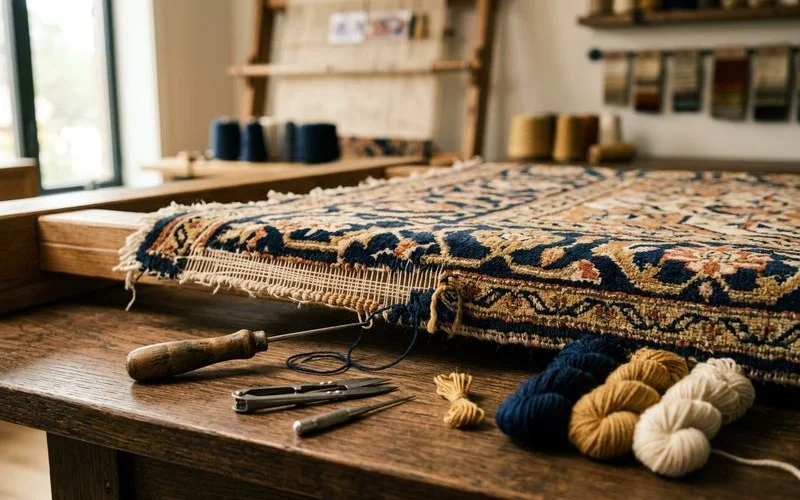
For straight cuts under three inches, the final result is essentially undetectable. Custom dyed yarns blend seamlessly with the aged patina of the surrounding wool.
| Damage Type | Foundation Status | Repair Complexity |
|---|---|---|
| Straight Knife Cut | Cleanly severed warp/weft | Low to Moderate |
| Puncture Hole | Missing or distorted fibers | Moderate to High |
Large rotted areas
Dry rot from prolonged moisture, pet urine, or advanced age severely weakens the rug’s structural foundation in localized areas. We stabilize mild rot and can completely rebuild moderately rotted sections. Large rotted areas often require a master weaver to execute a full foundation rebuild.
Placing heavy, moisture-retaining potted plants directly on wool carpets is a frequent cause of hidden rot. Water slowly seeps through the pot, trapped against the cotton foundation fibers. Cotton naturally degrades and becomes brittle when subjected to constant dampness over several months.
Our repair specialists test the foundation by gently listening for a distinctive cracking sound when bending the rug. A stiff, brittle feel indicates the cellulosic fibers have failed.
“Never place a live potted plant directly on a natural fiber rug. The trapped moisture will inevitably cause irreversible dry rot within a single season.”
Missing corners
Missing or worn corners are rebuilt by re-extending the foundation, reweaving the pile, and fully restoring the side edges. Corners get worn much faster than the rest of the rug because they are exposed to foot traffic in three dimensions. People catch their shoes on curling tips, causing rapid physical degradation.
A damaged corner rapidly loses its heavy wool binding. We often see structural failure starting at the very tip and moving inward at a 45-degree angle. This diagonal loss ruins the visual symmetry of decorative borders.
The repair process involves securing the rug to a frame and weaving new cotton warp threads into the existing body. Skilled artisans then knot matching wool over this new grid. Applying a stiffening solution or sewing leather strips to the back helps the new corners lay perfectly flat.
- Place heavy furniture on corners in high-traffic zones.
- Rotate the rug 180 degrees every six months to distribute wear.
- Attach non-slip rug pads designed specifically for corner anchoring.
Worn edges and unraveling ends
Selvage breakdown along the sides and fringe damage on the ends represent some of the most critical structural repairs. Both issues require immediate attention, because a failing edge causes the rug to unravel inward, losing valuable rows of hand-tied knots. Early intervention prevents exponentially larger repair bills later.
The side edges, known as selvages, are formed by wrapping heavy yarn around the outermost warp threads. Foot traffic and vacuum cleaners eventually abrade this protective wrapping. Once the binding cord breaks, the interior knots are entirely exposed.
We lock the ends using an overcasting stitch to prevent further knot loss. This specialized technique creates a secure barrier across the width of the piece. Rebinding the selvages with color-matched wool thread fully restores the original factory edge.
| Edge Location | Technical Term | Primary Function |
|---|---|---|
| Side Edges | Selvage | Protects the lateral structure |
| End Edges | Fringe/Kilim | Locks the vertical warp threads |
Moth damage
Wool moth larvae consume the foundation and pile, leaving behind completely bald patches and severely weakened areas. We rebuild these eaten sections only after completing a thorough moth treatment to eradicate the active infestation. The Webbing Clothes Moth, scientifically known as Tineola bisselliella, is the primary culprit behind this destruction.
Adult moths do not actually eat the wool fibers. The female lays hundreds of eggs in dark, undisturbed areas, such as underneath a heavy sofa. The hatched larvae then feed voraciously on the keratin protein found naturally in sheep wool.
Our restoration process begins with freezing or chemically treating the rug to kill all remaining larvae and eggs. Re-knotting the bald patches requires extreme precision, as the surrounding foundation is often surprisingly fragile.
Look for these common signs of active moth activity:
- Small, sticky tubes or webbing hidden deep in the pile.
- Granular, sand-like debris collecting under the carpet.
- Bald spots appearing suddenly in low-traffic areas.
Burn damage
Cigarette burns, fireplace ember marks, or intense heat damage can sometimes be repaired by carefully removing the damaged section and rebuilding it. Larger burn areas might require cutting out the entire charred section and weaving a completely new insert.
Natural wool is naturally flame retardant, meaning it tends to self-extinguish rather than combust. Fireplace embers popping onto a hearth rug usually cause localized surface scorches rather than deep structural fires.
We trim away the brittle, blackened fibers to assess the depth of the damage. Minor surface scorches are often corrected through careful shearing and washing. Deep ember burns that penetrate the cotton foundation require the exact same reweaving process as a puncture hole.
“Placing a protective fire-resistant pad over hearth rugs during active fireplace use prevents 90% of accidental ember burns.”
What we can’t always fix
Some damage is simply beyond practical restoration due to severe structural compromise or ruined dye. When the cost of repair heavily exceeds the current appraisal value of the piece, replacement is the honest answer. We will clearly tell you upfront if a carpet is not worth the financial investment to fix.
Certain chemical and physical issues permanently destroy the materials. Extensive bleach spills strip the natural dyes completely, making accurate color matching nearly impossible. Severe, widespread dry rot leaves the cotton warp threads so brittle that a needle cannot pass through them without causing further tearing.
Inexpensive, machine-made rugs often suffer complete foundation degradation from age. The synthetic glues holding them together break down, turning to a powdery dust.
Some damage is beyond restoration:
- Severe widespread dry rot that has compromised the foundation across most of the rug.
- Bleach damage that has destroyed dye over large areas.
- Complete foundation degradation from age in inexpensive rugs.
For these cases, reviewing the numbers makes the choice clear. See our repair vs replace a rug guide for the decision framework.
Inspection first
Every repair starts with a free pre-inspection to properly evaluate the physical condition of the fibers. We document the exact damage, explain what is reversible, and provide a clear roadmap for restoration. You decide exactly what to prioritize based on your budget and goals.
Specialized tools are used during this initial assessment. Ultraviolet (UV) light wands reveal hidden pet urine stains that might not be visible to the naked eye. Jewelers loupes help determine the exact knots per square inch (KPSI), dictating the density of the required reweaving.
We give you a separate, itemized price for each distinct repair component. Breaking down the costs for fringe replacement, edge binding, and hole reweaving allows for smart decisions.
| Repair Priority | Issue | Consequence of Delay |
|---|---|---|
| 1. Structural | Unraveling edges | Rapid knot loss |
| 2. Foundation | Dry rot or holes | Tearing and spreading |
| 3. Cosmetic | Faded pile or scorches | Visual detraction |
Fixing structural issues first often makes the most financial sense. Schedule your complimentary pre-inspection today to map out the best restoration plan for your specific piece.
Related Service
Rug Repair & Restoration
Restoration for holes, cuts, dry rot, worn corners, edges, and fringe, including master-weaver reweaving.
Learn more about Repair & RestorationRelated Rug Care Guides
Repair vs. Replace: Is Your Rug Worth Restoring?
Should you restore or replace a damaged rug? Weigh sentimental and market value, damage extent, and cost, plus why hand-knotted rugs are worth saving.
Reweaving Missing Foundation & Pile
Reweaving rebuilds a rug's foundation and pile knot by knot, with color-matched wool. The high-end restoration path and our master-weaver partnership.
Rug Fringe Repair & Replacement
Fraying or missing fringe? How we secure rug ends to stop unraveling, rebuild or replace fringe, surge edges, and when fringe is structural.
How Much Does Rug Repair Cost?
Rug repair is priced by type, fringe, edge, hole, or full reweave. Typical Nevada cost factors, why we quote after inspection, and value vs replacement.
Frequently Asked Questions
Can a hole in a rug be repaired?
Is pet-chewed damage fixable?
Is the rug worth repairing?
Have a Rug You'd Like Us to Look At?
Free pre-inspection, transparent quoting, and pickup across Las Vegas.
Get My Free Quote