
Hand-Knotted vs. Tufted Rugs: What Can Be Cleaned & Restored
Tufted rugs use latex backing that degrades and off-gasses; hand-knotted rugs last generations. What each can take and when restoration is worth it.
Understanding the difference between a hand knotted vs tufted rug is the single most important factor when deciding how to care for your floor coverings.
We completely understand the hesitation, especially when facing expensive repair bills.
As the team at Legacy Rug Cleaning, providing expert care and restoration services has shown us exactly what fails and what lasts.
The construction of your piece determines almost everything about its cleaning options and remaining lifespan.
Before deciding whether a professional intervention is worth the money, you simply have to look at the back. For repair services on construction that is actually worth saving, see Rug Repair & Restoration.
We will break down exactly how to identify your rug type, explain the lifespan differences, and outline the true costs of repair.
How to tell the two apart
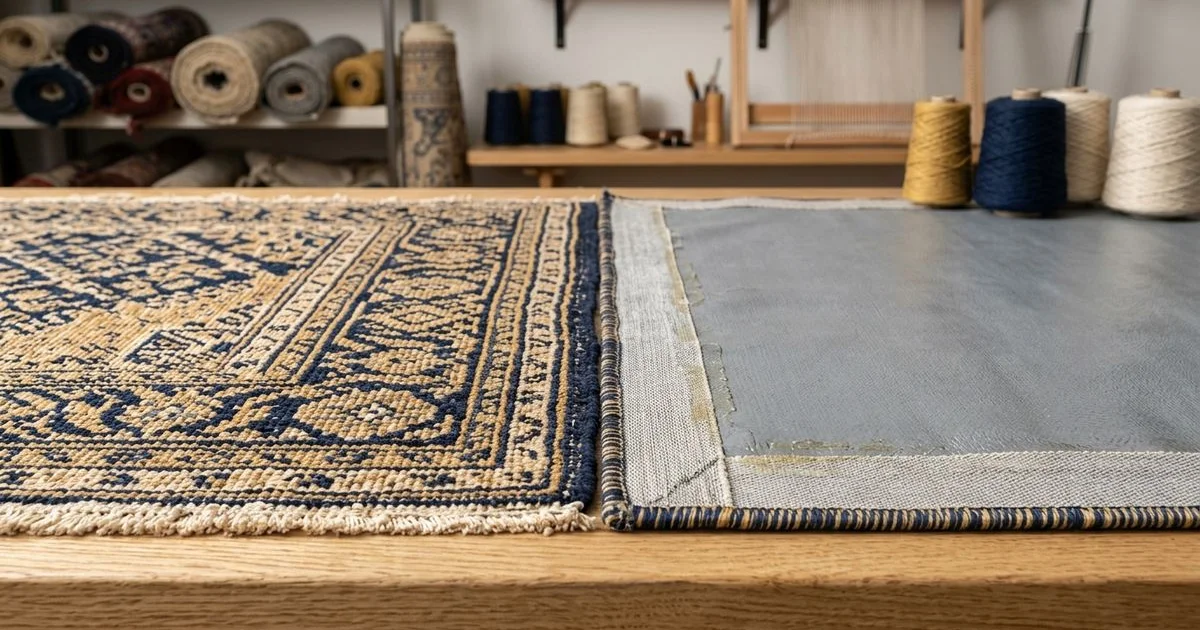
The quickest way to tell a hand-knotted rug from a tufted piece is by checking the back for a glued fabric covering. Tufted rugs hide their inner construction under a canvas layer, whereas hand-knotted pieces proudly display every single knot.
We always start our inspections by flipping the corner of the rug over. This simple action reveals the true manufacturing method immediately.
Spotting a Hand-Knotted Piece
Hand-knotted: Flipped over, the pattern perfectly mirrors the front design. Individual knots remain clearly visible across the entire foundation. The fringe acts as a natural continuation of the warp threads, rather than existing as a separately sewn trim.
A high-quality Persian or Oriental piece often features hundreds of knots per square inch (KPSI). This dense construction gives the rug substantial weight proportional to its size.
Identifying Tufted Construction
Tufted: On the reverse side, you will see a solid fabric backing. Manufacturers use canvas or scrim material, firmly glued to the back of the rug to secure the yarns. No individual knots are visible anywhere on this surface.
If fringe is present, builders sew or glue it on as an afterthought, rather than weaving it into the foundation. These rugs typically feel much lighter for their size compared to woven alternatives.
We put together a quick comparison to help you spot the differences at home.
| Feature | Hand-Knotted Rugs | Tufted Rugs |
|---|---|---|
| Backing Material | Exposed knots and foundation threads | Glued canvas or scrim fabric |
| Fringe Style | Natural extension of the warp | Sewn or glued onto the edges |
| Weight & Feel | Heavy, dense, and flexible | Lighter, stiff, and rigid |
| Construction Method | Tied individually by hand | Punched through fabric with a tool |
Why tufted rugs have a lifespan
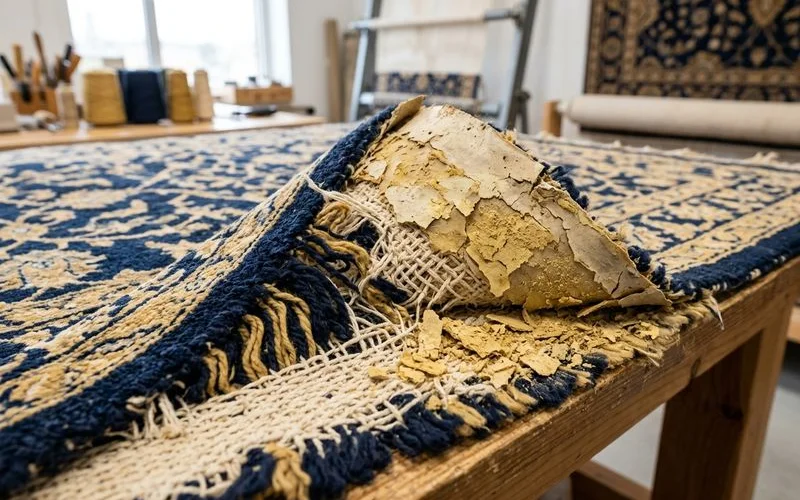
Tufted rugs have a hard expiration date because they rely on latex adhesive, rather than woven knots, to hold the pile together. Most of these pieces last 5 to 10 years before the glue inevitably degrades.
Manufacturers use synthetic latex, often a styrene-butadiene rubber (SBR) blend, to secure the yarn to the canvas backing. Over the years, this chemical mixture loses its elasticity and fails. We frequently see older tufted rugs shedding a fine, powdery white dust onto hardwood floors.
This residue is the dried-out adhesive crumbling away from the fabric. As the latex breaks down, it also off-gasses volatile organic compounds (VOCs) like 4-phenylcyclohexene. The classic tufted rug latex smell, often described as burnt rubber or ammonia, is simply the adhesive announcing it has reached the end of its life.
The Limits of Tufted Cleaning
This chemical degradation severely limits your maintenance options. Aggressive washing accelerates the latex breakdown by re-wetting and weakening the fragile glue.
We have seen completely delaminated rugs where the canvas backing separates from the top layer entirely during a heavy soak. Even the most careful surface cleaning cannot reverse the decay.
Professional maintenance only slows the process down. After a decade of normal use, the cost of replacement usually drops below the price of extensive repairs.
Signs Your Tufted Rug is Failing
Catching the signs of adhesive decay early helps you avoid a messy cleanup on your floors. Look for these common symptoms:
- White powder on the floor: Dried glue crumbling from the foundation.
- A strong rubber odor: Chemical off-gassing from the aging latex.
- Stiff or crunchy backing: Loss of elasticity in the canvas layer.
- Separating layers: The fabric peeling away from the yarn.
Why hand-knotted rugs are different
Hand-knotted rugs completely skip the latex adhesive, meaning they never suffer from glue rot or chemical breakdown. Because the pile is held to the foundation by individual knots, these pieces easily outlast their synthetic counterparts.
We marvel at the sheer resilience of these traditional floor coverings. With proper care, a wool or silk hand-knotted rug easily lasts 50 to 100 years. See hand-knotted rug construction explained for the exact structural details.
The structural integrity comes from a strong grid of cotton or wool warp and weft threads. This tightly woven foundation is why hand-knotted pieces remain prime restoration candidates regardless of the specific damage.
Repairing the Unfixable
A high-quality woven rug survives incidents that would immediately ruin a tufted piece. A heavily moth-eaten section requires reweaving, but the surrounding structure stays perfectly intact.
A worn corner from years of foot traffic simply needs a skilled rebuilder to secure the edges. We have successfully restored flooded antiques that seemed entirely beyond saving at first glance.
The core foundation supports intricate repair work that a glued tufted backing simply cannot handle.
The repair decision
Repairing a tufted rug rarely makes financial sense once the backing starts peeling, while fixing a hand-knotted piece is almost always a smart investment. You have to weigh the current market value against the cost of specific repairs.
We always advise clients to look at the numbers before committing to a major project. When clients ask, “is my rug worth cleaning after the backing peels?” the answer usually comes down to the replacement cost.
For tufted rugs, repair work is generally limited to basic surface cleaning and minor edge adjustments. Major restoration is not economical because the degrading backing strictly limits the rug’s remaining life.
Current Costs for Restoring Hand-Knotted Pieces
For woven antiques or sentimental items, repair is absolutely worth exploring. The upfront work might seem significant, but the final result is a rug that returns to active use for decades.
We track national repair averages to give our customers a realistic baseline for their budgets. Basic fringe binding or overcasting typically costs around $30 to $50 per linear foot.
Patching small holes or fixing pet damage usually ranges from $100 to $300, depending on the complexity of the pattern.
If you are not sure what you have sitting on your floor, bring the rug in for a free pre-inspection. We will tell you the exact construction method, the current condition, and the most realistic options moving forward.
Related Rug Care Guides
How Much Does Area Rug Cleaning Cost in Nevada?
Nevada area rug cleaning runs roughly $4-$12 per sq ft by fiber and condition. What drives price (urine, size, repairs) and what an estimate includes.
Hand-Washing vs. In-Home Steam Cleaning for Fine Rugs
Why hot-water extraction with detergent risks color bleeding, shrinkage, and dry rot in fine rugs, and when steam is acceptable vs full submersion.
How Often Should You Professionally Clean an Area Rug?
Most area rugs need professional cleaning every 1-3 years, sooner with pets, kids, or heavy traffic. Fiber-specific guidance and between-wash care.
How Old-World Area Rug Hand-Washing Works
The Old-World submersion hand-wash step by step, dry dusting, an individual pH-balanced bath, controlled drying, and why it beats machine cleaning.
Frequently Asked Questions
Can tufted rugs be cleaned?
Why does my rug smell like rubber?
How do I tell if my rug is hand-knotted?
Have a Rug You'd Like Us to Look At?
Free pre-inspection, transparent quoting, and pickup across Las Vegas.
Get My Free Quote