
How Often Should You Professionally Clean an Area Rug?
Most area rugs need professional cleaning every 1-3 years, sooner with pets, kids, or heavy traffic. Fiber-specific guidance and between-wash care.

We hear a common question from clients regarding their fine floor coverings: how often should you professionally clean an area rug? Many homeowners focus on daily vacuuming but miss the silent accumulation of soil deep within the foundation.
At Legacy Rug Cleaning, our dedicated restoration experts know that quality care extends the life of these pieces by decades. For the cleaning service, see Oriental & Persian Rug Cleaning.
This guide will examine the actual data behind dirt accumulation and help you determine your ideal rug cleaning frequency.
The general guideline: every 1 to 3 years
For most residential area rugs under normal use, professional cleaning every 1 to 3 years is the standard recommendation. Where your piece falls in that range depends heavily on your specific household conditions.
We often tell clients that appearances are deceiving. A well-known study by the Eureka Company revealed that a standard 9x12 rug can hold up to 87 pounds of dirt before looking visibly soiled.
That hidden grit acts like sandpaper against the delicate fibers. Regular washing removes this abrasive soil before it shears the foundation.
Adjust for household type
Different living situations demand different schedules. We base our recommendations on the specific traffic and environmental factors in your home.
Pet households
Pet owners should plan on a shorter 12 to 18-month cycle. Hair, dander, and skin oils quickly bypass the reach of standard vacuuming.
We see the worst damage from untreated accidents. Fresh dog or cat urine starts mildly acidic with a pH around 5 or 6.
As it dries, the liquid turns highly alkaline, reaching a pH of 10 to 12. This shift releases ammonia gas and actively bleaches the dye structure of the rug. Any urine incident requires earlier attention, ideally same-month decontamination before those crystallized salts set deep.
Households with young children
Family rooms see frequent spills and heavy foot traffic. Plan on an 18 to 24-month schedule for these high-use spaces. Kids spend significant time on the floor, making sanitation a clear priority.
Allergy-sensitive households
The EPA ranks indoor air pollution among the top five environmental health risks. Dust mites, allergens, and microscopic biological contaminants settle heavily into woven foundations.
Our annual cleaning recommendation helps sensitive households breathe easier. Washing physically flushes these allergens out of the home.
Formal-room rugs
Pieces in formal, low-traffic rooms can stretch to a 2 to 3-year cycle. Please avoid waiting longer than three years.
We find that atmospheric soils, cooking oils, and dust still settle into the fibers over time. Embedded soil compounds slowly even when nobody walks on the surface.
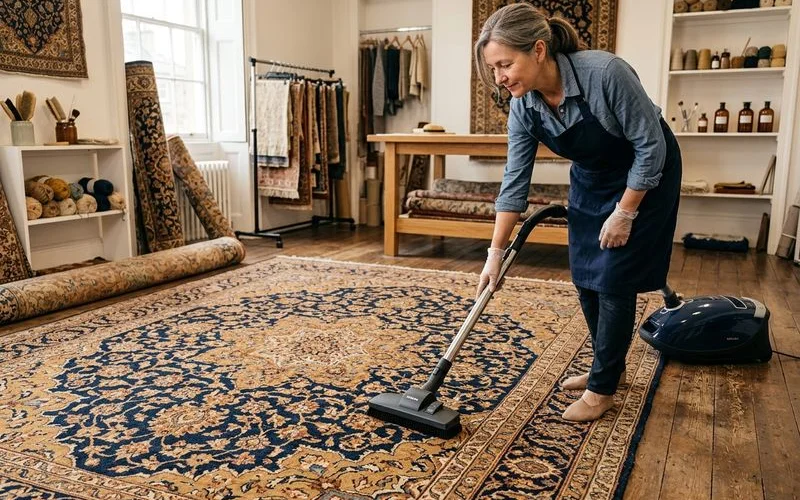
Fiber matters too
The material of your rug dictates both its durability and its washing requirements. Clients frequently ask us how often to wash a wool rug compared to a synthetic one.
We adjust our approach based on the specific textiles involved. Natural materials behave very differently than synthetics when exposed to moisture and friction.
| Fiber Type | Cleaning Frequency | Key Vulnerabilities & Care Facts |
|---|---|---|
| Wool | 12 to 18 months | Wool is highly forgiving and naturally hides dirt due to its opaque, scaled structure. Regular washing prevents hidden grit from severing the strong natural fibers. |
| Silk and Viscose | 2 to 3 years | Viscose (often sold as “art silk” or rayon) loses up to 50% of its structural strength when wet. These delicate fibers are highly prone to cellulose browning and distortion. |
| Hand-Knotted Persian | 2 to 3 years | These durable pieces require gentle dusting and specialized washing. For antique and heirloom rugs, attentive care prevents the cotton foundation from suffering dry rot. |
Between-wash care matters more than people think
What you do between professional washes directly affects how long the piece looks and feels right. We encourage clients to build a simple, consistent maintenance routine.
These small habits reduce the cumulative soil load and prevent permanent sun fade.
Essential Home Maintenance Tips
- Use a certified vacuum: The Carpet and Rug Institute (CRI) tests and certifies vacuums that remove soil without damaging textiles. Use a machine on their approved list.
- Turn off the beater bar: Always vacuum with the suction-only setting. Beater bars aggressively pull at the pile and can unravel the fringe.
- Vacuum the back: Flipping the rug over twice a year is a great practice. Run the vacuum gently over the back to vibrate dry dirt out of the front pile.
- Rotate frequently: Spin the rug 180 degrees every six months to ensure even wear patterns.
- Blot, never rub: When spills happen, press a clean white towel firmly into the spot to absorb liquid. Rubbing permanently distorts the wet fibers.
- Install window protection: Apply UV-filtering window film to west-facing or south-facing glass. This blocks the ultraviolet rays that fade vibrant dyes.
Don’t wait for “dirty”
The biggest mistake owners make is waiting until a piece looks visibly stained or dark. By that point, embedded grit has been wearing the foundation for many months.
Our experts know that the physical damage of waiting too long is permanent. Washing removes dirt, but it cannot replace missing pile.
If you cannot remember the last time your rug was professionally washed, it has been too long. See the signs your rug needs cleaning for common warnings, and schedule a free pre-inspection today to protect your investment.
Related Rug Care Guides
How Much Does Area Rug Cleaning Cost in Nevada?
Nevada area rug cleaning runs roughly $4-$12 per sq ft by fiber and condition. What drives price (urine, size, repairs) and what an estimate includes.
Hand-Knotted vs. Tufted Rugs: What Can Be Cleaned & Restored
Tufted rugs use latex backing that degrades and off-gasses; hand-knotted rugs last generations. What each can take and when restoration is worth it.
Hand-Washing vs. In-Home Steam Cleaning for Fine Rugs
Why hot-water extraction with detergent risks color bleeding, shrinkage, and dry rot in fine rugs, and when steam is acceptable vs full submersion.
How Old-World Area Rug Hand-Washing Works
The Old-World submersion hand-wash step by step, dry dusting, an individual pH-balanced bath, controlled drying, and why it beats machine cleaning.
Frequently Asked Questions
How often should I clean a rug if I have pets?
Does a low-traffic rug really need professional cleaning?
Should I rotate my rug?
Have a Rug You'd Like Us to Look At?
Free pre-inspection, transparent quoting, and pickup across Las Vegas.
Get My Free Quote