
Repairing Moth-Eaten Wool Rugs
Moths leave bald patches and eaten foundation. How we assess the damage, reweave pile and foundation, and when damage is too extensive to restore.
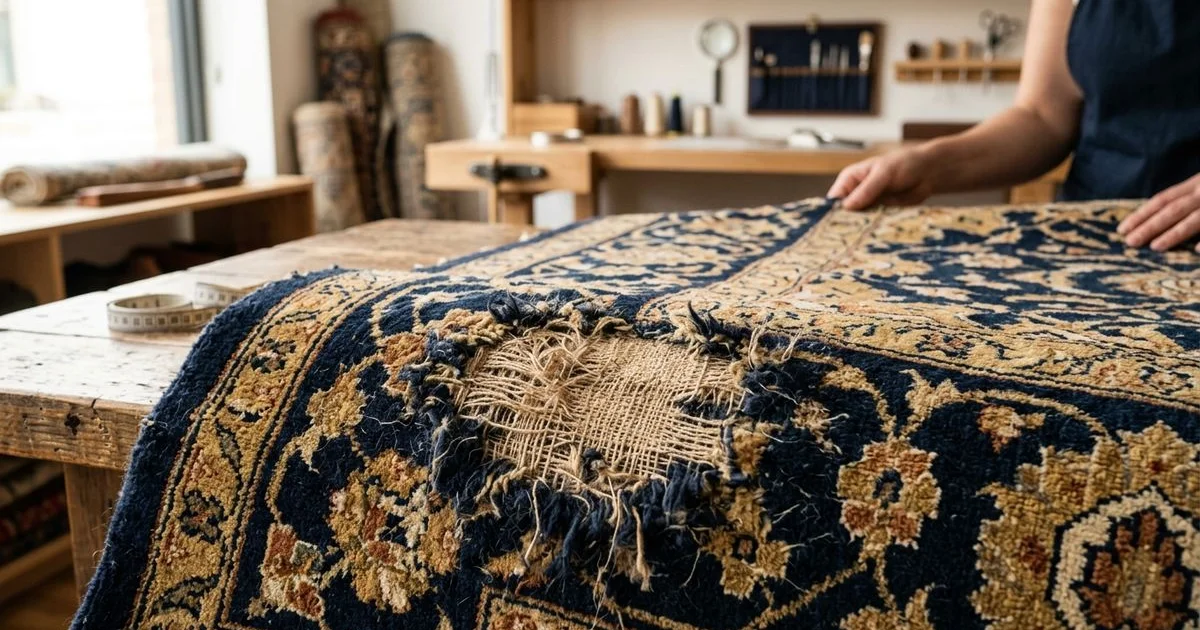
From what I have seen over the years, discovering a bare spot on a beloved family heirloom feels like a disaster. That initial shock is usually unwarranted. Most visible damage on a hand-knotted wool piece is completely reversible.
We find that to repair moth eaten rug textiles successfully, you just need a methodical approach. The real challenge is stopping the active infestation before addressing the cosmetic issues. This is exactly why starting with comprehensive Moth Treatment & Removal remains critical.
Let’s look at the data behind these infestations.
I will outline the exact restoration techniques that bring your investment back to life.
What moth damage looks like
Active moth damage typically presents as irregular bald patches, visible foundation threads, and sticky webbing residue. The true extent of this destruction is usually much deeper than the surface missing pile.
We frequently discover that larvae feed extensively on the underside before breaking through the top layer. The primary culprits in the US are the Webbing Clothes Moth (Tineola bisselliella) and the Casemaking Clothes Moth (Tinea pellionella).
Their larvae consume the keratin protein found in animal fibers, leaving behind several distinct warning signs:
- Gritty, powdery droppings known as frass hidden deep in the pile.
- Small silken tubes measuring about 1/8-inch long where the larvae feed.
- Irregularly shaped bald spots that grow larger over time.
Treatment first, restoration second
Before a needle ever touches the fabric, the piece requires total eradication of the insects. Repairing a rug while live larvae or unhatched eggs remain simply provides new food for the pests.
Our team insists on a strict sequence here. You cannot skip this step safely because a single female clothes moth lays 40 to 50 eggs deep inside the dark, undisturbed areas of the pile.
Those eggs hatch in just 4 to 10 days under typical warm household conditions, making rapid intervention critical.
Our moth containment and treatment process uses deep freezing or specialized commercial treatments to achieve a 100% kill rate on all life stages. This completely stops the cycle.
Restoration approach
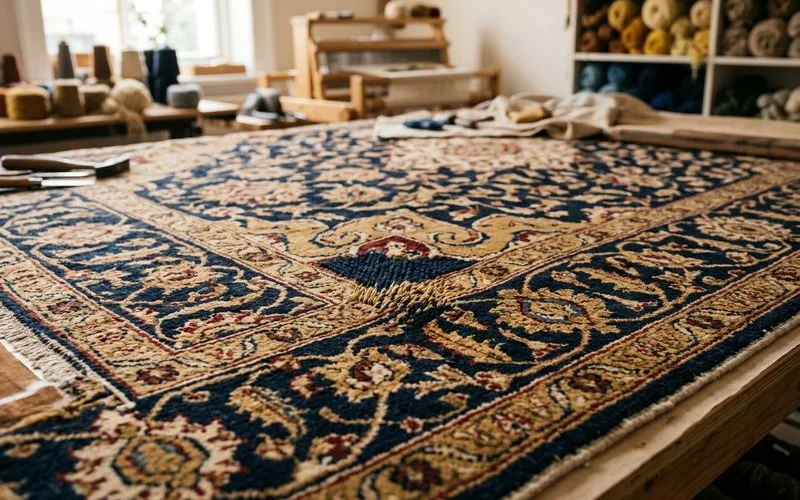
After confirming the piece is pest-free, technicians rebuild the missing foundation and re-tie the wool knots to match the original pattern. The specific technique depends entirely on where the feeding occurred.
We treat every piece as a unique architectural rebuild. The structural repair always dictates the final cosmetic result.
Repairing the Foundation (Warp and Weft)
The internal skeleton of your piece consists of vertical warp threads and horizontal weft threads. Moths usually avoid these base threads because they are typically made of cotton, which lacks the keratin protein they need to survive.
Our specialists must hand-warp new cotton strings into the grid if heavy infestations cause structural weakness. This step provides the anchor for the new pile.
Reweaving the Missing Pile
The process of filling bald patches requires tying new yarn onto the foundation one knot at a time. The technician carefully studies the original knot density to ensure the repair sits flush.
We replicate the specific tension of the original piece. A highly detailed Persian Tabriz rug might require 400 knots per square inch. You can see reweaving missing foundation and pile for a closer look at this detailed reweaving process.
Securing Edges and Selvages
Moths naturally gravitate toward dark edges and undisturbed borders against baseboards. The larvae often chew through the protective side cords before moving inward.
Our technicians perform edge surging and selvage rebuilding to restore structural integrity. This prevents the side unraveling from spreading into the main field.
Precision Color Matching
The replacement wool yarn must match the original colors precisely under natural daylight. Antique pieces with unusual or faded vegetable dyes require custom dye mixing.
We match the specific ply and twist of the original hand-spun wool. An exact match ensures the patched area blends invisibly into the surrounding field.
When damage is too extensive
Sometimes a textile suffers such severe structural loss that a full repair no longer makes economic sense. If the structural deterioration exceeds 30% of the total surface area, replacement becomes the more practical option.
Our specialists evaluate the hidden warp and weft threads first. Dry rot and age-related fiber weakness complicate the process significantly.
It is not always economical to fix moth damaged wool rug pieces under these specific conditions:
- Widespread feeding across most of the rug surface.
- Severe cotton foundation damage across multiple large sections.
- Damage combined with significant age-related fiber weakness or dry rot.
We always provide an honest assessment of the remaining value. Sometimes a partial restoration to preserve the rug for wall display is appropriate, but in other cases, buying a new piece is simply the smartest financial decision.
What it costs to repair moth eaten rug damage
Pricing depends directly on the knot density of the original piece and the total square inches of the affected area. Complex jobs requiring a master weaver run higher than basic edge repairs.
We base our pricing models on the time required to match the original craftsmanship. An intricate repair can require two to four hours of labor per square inch. See rug repair cost in Nevada for general ranges.
The complexity of the task drives the timeline and the final bill. Here is a breakdown of how different damage types compare:
| Damage Type | Estimated Repair Timeline | Complexity Level |
|---|---|---|
| Small Surface Patch | 1 to 2 weeks | Low |
| Edge or Selvage Rebuild | 1 to 2 weeks | Medium |
| Large Foundation & Pile Reweave | 3 to 6 weeks | High |
For most household-sized moth-damage repairs, the cost is significantly less than full replacement. Catching the issue early saves thousands of dollars.
Why hand-knotted moth damage is restorable
Hand-knotted textiles possess a grid-like skeleton made of vertical warp and horizontal weft threads. This distinct construction allows artisans to recreate the missing sections knot by knot.
Our industry relies on this underlying structural integrity to restore moth eaten rug fibers. The pile is manually tied to the foundation grid, meaning new pile can be tied into place using the exact same traditional methods.
Tufted rugs present a completely different scenario:
- Manufacturers use latex glue to hold the tufted fibers against a canvas backing.
- Moths chew through this glued layer easily.
- Once the backing degrades, the structural loss is permanent and economically unviable to fix.
After restoration
Once the repairs conclude, the textile returns to your home fully cleaned and protected against future infestations. Maintaining that protection requires routine vacuuming and environmental monitoring.
We always recommend implementing a strict prevention plan immediately upon delivery. You can review the exact protocols for preventing moth damage in stored rugs to keep your textiles safe.
Here are our top ongoing prevention strategies:
- Vacuum the backs of your rugs every three months.
- Rotate pieces sitting under heavy furniture.
- Schedule professional cleanings every two to three years.
Do not rely solely on pheromone traps. These traps only catch adult males and do absolutely nothing to stop the larvae currently destroying your piece.
If you are ready to repair moth eaten rug damage in your home, reach out to a professional restorer today.
Related Service
Moth Treatment & Removal
Containment, removal, and treatment of wool moth infestations, with pest-control coordination and post-damage repair.
Learn more about Moth TreatmentRelated Rug Care Guides
How Moth Containment & Treatment Works
From isolation to eradication, how we contain a moth-infested rug, wash and treat to kill larvae and eggs, and coordinate pest control to stop the spread.
Preventing Moth Damage in Stored Rugs
Moths love stored wool. How to prevent damage during storage, clean first, wrap professionally, control climate, and inspect on a schedule.
Signs of a Wool Moth Infestation in Rugs
Spot a moth problem early, webbing, shed casings, bald patches, and larvae hiding under furniture. The warning signs before moths ruin a wool rug.
Frequently Asked Questions
Can moth holes really be repaired?
Should I treat the moths before repairing?
Is moth damage ever unrepairable?
Have a Rug You'd Like Us to Look At?
Free pre-inspection, transparent quoting, and pickup across Las Vegas.
Get My Free Quote