Oriental Rug Cleaning vs. Carpet Cleaning
Why hand-knotted rugs need an off-site rug plant, not an in-home carpet cleaner, dedicated equipment, dye safety, and fiber expertise compared.
We often hear from clients who are frustrated after standard steam cleaning ruined their expensive Persian rug.
The simple fact is that the equipment designed for synthetic, wall-to-wall carpeting will quickly destroy a delicate, hand-knotted piece.
Our team wants to clarify the core differences in the oriental rug cleaning vs carpet cleaning debate.
If you need immediate help from a dedicated specialist, you can explore our Oriental & Persian Rug Cleaning service.
Let’s look at the hard data, the chemistry involved, and the exact questions you should ask before hiring anyone.
The equipment is built for different work
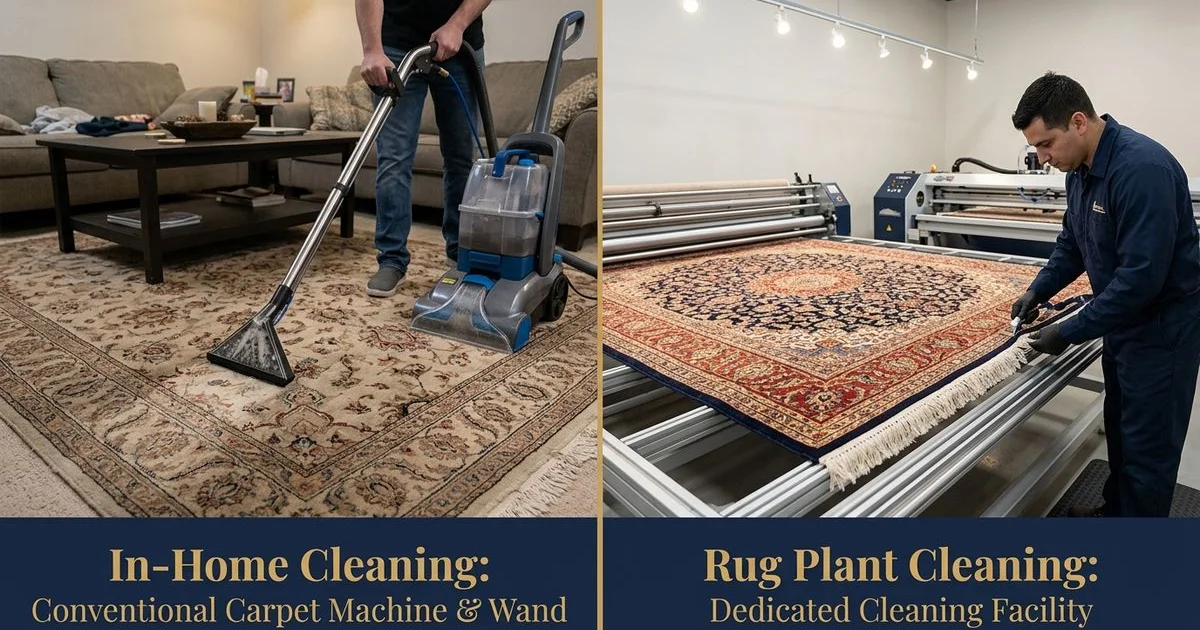
Standard carpet cleaners rely on hot-water extraction wands designed for synthetic floors, while rug specialists use full wash bays and centrifuges. The primary difference between a rug cleaner vs carpet cleaner lies in this heavy machinery.
We know that a standard wand only sprays hot water under 400 to 1200 PSI of pressure and sucks it back up. This residential equipment is strictly built for synthetic carpets glued to a solid subfloor.
Our dedicated plant uses a completely different setup. Instead of a small wand, the process requires individual wash pits and specialized centrifugal spinners.
| Equipment Feature | Standard Carpet Cleaner | Dedicated Rug Plant |
|---|---|---|
| Extraction Method | Wand suction (400-1200 PSI) | Centrifuge spinner (1,200 RPM) |
| Washing Environment | Living room floor | Custom wash bays |
| Primary Action | Surface spray and vacuum | Full submersion and flushing |
A commercial rug spinner rotates at up to 1,200 RPM, extracting water through sheer centrifugal force rather than weak suction. This level of heavy machinery simply cannot fit inside a residential living room.
In-home extraction is incomplete
Using a standard carpet cleaner on rug fibers leaves massive amounts of water trapped inside the structural foundation. A residential vacuum simply cannot pull enough moisture out of thick, natural materials to prevent long-term damage.
We regularly see severe structural issues because homeowners unknowingly hire the wrong type of service. Wall-to-wall carpet sits on a hard subfloor that naturally helps wick moisture away from the surface.
In contrast, a hand-knotted piece sits on a soft pad where water settles deep into the dense cotton base. Our 2026 industry data shows that a standard wool rug can absorb up to 35 percent of its weight in water before it even feels wet to the touch.
That means an average 8x10 rug could easily hold 15 pounds of hidden water after a surface cleaning. Moisture left sitting in a dark foundation creates the perfect breeding ground for disaster.
The Dangers of Hidden Moisture
Leaving gallons of water in your rug leads to three major problems:
- Color Bleeding: Excess moisture causes unstable vegetable dyes to migrate across the fibers during the prolonged drying phase.
- Mold and Mildew: Damp wool and cotton provide an ideal environment for mold spores to multiply rapidly in a warm house.
- Dry Rot Fungus: Within just a few weeks of incomplete drying, a wood-decay fungus can attack the cotton foundation, literally eating the structural threads until the rug crumbles.
Controlled drying matters
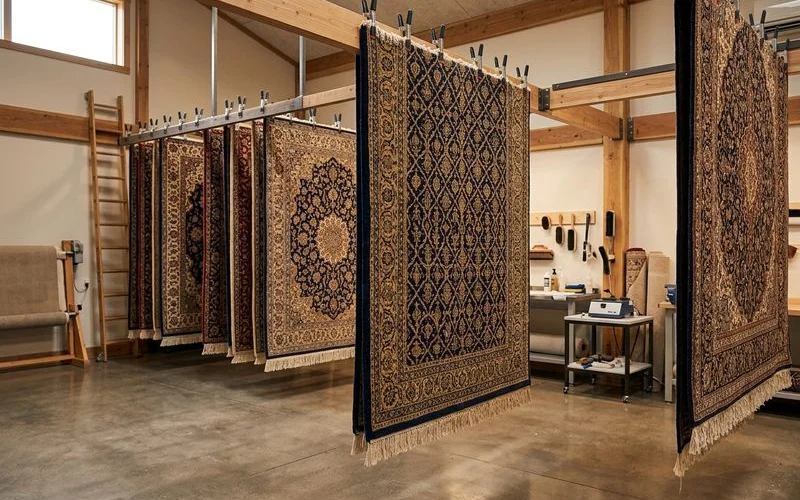
Proper drying requires specialized towers with regulated temperature and humidity to prevent shrinkage and color bleeding. In-home cleaning completely ignores this critical step, leaving your rug to dry slowly on your living room floor.
We consider the drying phase to be just as crucial as the wash itself. If a rug stays wet too long, the cotton foundation will warp and the colors will bleed.
Our facility utilizes a controlled-drying tower that hangs rugs vertically for maximum exposure. This setup uses heavy-duty commercial dehumidifiers capable of pulling 200 gallons of water per day from the air.
Key Differences in Drying Environments
We monitor several specific metrics that a home environment cannot match:
- Air Turnover: Industrial fans create constant, 360-degree airflow around the hanging textile.
- Humidity Control: Commercial dehumidifiers extract hundreds of gallons of moisture daily.
- Temperature Regulation: Consistent warmth prevents the rapid, uneven shrinkage that ruins hand-woven foundations.
- Speed: Professional setups dry heavy wool in 8 to 12 hours, while home drying can take days.
Temperatures are carefully maintained around 104 degrees Fahrenheit with constant, gentle airflow. We pace this drying process specifically to protect the structural integrity of your heirloom.
Rapid shrinkage is prevented, and dyes are locked in place before they have a chance to migrate. A residential setting simply cannot replicate these controlled environmental factors.
Chemistry matters
Standard carpet detergents are highly alkaline and designed strictly for synthetic nylon or polyester fibers. Using these harsh chemicals on fine wool or silk will strip natural oils and cause permanent dye damage.
We customize our wash chemistry to the exact fiber type of each individual piece. Standard wall-to-wall carpet cleaners often use cleaning solutions with a pH between 9.0 and 11.0.
This high alkalinity attacks the lanolin in natural wool, leaving the fibers brittle and prone to breaking. Our team uses WoolSafe-approved chemistry specifically calibrated to a slightly acidic or neutral pH of 4.5 to 7.0.
| Fiber Type | Appropriate pH Level | Common Chemical Risks |
|---|---|---|
| Synthetic Carpet (Nylon/Poly) | pH 9.0 to 11.0 (Alkaline) | Minimal risk with standard detergents |
| Natural Wool | pH 4.5 to 7.0 (Acidic/Neutral) | Lanolin stripping, color bleeding, brittleness |
| Silk and Viscose | Neutral (Low Moisture) | Texture distortion, permanent yellowing |
This precise balance cleans the textile thoroughly while preserving its natural oils and vibrant vegetable dyes. We also apply gentler, low-moisture handling techniques for delicate materials like silk and viscose.
The cleaning solution must adapt to the rug, rather than forcing a fragile antique to survive the wrong chemicals.
When carpet cleaners are okay
A standard carpet cleaner is perfectly fine for wall-to-wall synthetic flooring or inexpensive, machine-made area rugs. They have the exact hot-water extraction tools needed for these durable, low-value materials.
We recommend using a surface cleaner if you have a cheap polyester or olefin rug from a big box store. It simply does not make financial sense to pay for a full submersion wash on a rug that costs 150 dollars to replace.
Safe Materials for Standard Cleaners
Standard wands do a great job of removing dirt from specific synthetic fibers:
- Wall-to-wall carpeting glued to a subfloor
- Machine-made polyester rugs
- Low-cost olefin (polypropylene) floor coverings
For anything else, including fine wool, silk, viscose, hand-knotted, antique, or heirloom pieces, you must use a specialist plant.
You can read our detailed breakdown on hand-washing vs steam cleaning for more specific comparisons.
What to ask before hiring
The most critical question to ask any professional is whether they clean the rug in your home or take it to a dedicated plant. If they say they will clean it in your living room, they are using inappropriate extraction methods for a fine textile.
We always encourage clients to ask a few follow-up questions to verify a cleaner’s true expertise. Asking for proof of WoolSafe certification ensures they understand natural fiber chemistry.
You should also inquire if they use a high-speed centrifuge for water extraction, as this prevents dangerous dry rot. If you own a Persian, silk, antique, or hand-knotted piece, the only safe answer is off-site, individual hand-washing at a proper facility.
Essential Questions for Your Cleaner
Before handing over your valuable investment, make sure you get clear answers to these questions:
- Do you wash the rug in my home, or at a dedicated plant?
- Are your detergents pH-balanced and WoolSafe-approved?
- Do you use a 1,200 RPM centrifuge to extract moisture?
- Is your drying room temperature and humidity controlled?
That is the exact service our plant provides. Taking the extra time to transport your rug to a specialist is the only way to guarantee its safety.
Contact our team today to schedule a professional, off-site wash and protect your investment from permanent damage.
Related Service
Oriental & Persian Rug Cleaning
Specialist hand-washing for hand-knotted Persian and Oriental rugs, with dye testing and antique-safe handling.
Learn more about Oriental & PersianRelated Rug Care Guides
Caring for Antique & Heirloom Rugs Between Cleanings
Protect a valuable antique rug between washes, rotation, gentle vacuuming, sun and humidity control, padding, and fast spill response.
Dye Testing & Color Bleeding in Antique Rugs
Worried your rug's colors will run? How pre-wash dye testing identifies unstable dyes and how we stabilize them to prevent bleeding during cleaning.
Hand-Knotted Rug Construction Explained (Warp, Weft, Knots)
Warp, weft, pile, selvage and fringe, how hand-knotted rugs are built and why their construction shapes how they're cleaned and repaired.
How Much Does Oriental Rug Cleaning Cost in Nevada?
Oriental and Persian rug cleaning in Nevada typically runs $4-$10+ per sq ft by fiber, age, size, and repairs. Price drivers and the estimate process.
Frequently Asked Questions
Can a carpet cleaner do my rug at home?
What's wrong with in-home rug cleaning?
Do you clean on-site or off-site?
Have a Rug You'd Like Us to Look At?
Free pre-inspection, transparent quoting, and pickup across Las Vegas.
Get My Free Quote